Editor's Picks

While working on a list of synonyms of European White Oaks...
Roderick Cameron
|
Aug 24, 2026
Report led by The Morton Arboretum will help prioritize oak...
Website Editor
|
Aug 06, 2026
Motivation
I live in the village of Dolné Dubové...
Jozef Čapkovič
|
Jul 20, 2026
Plant Focus
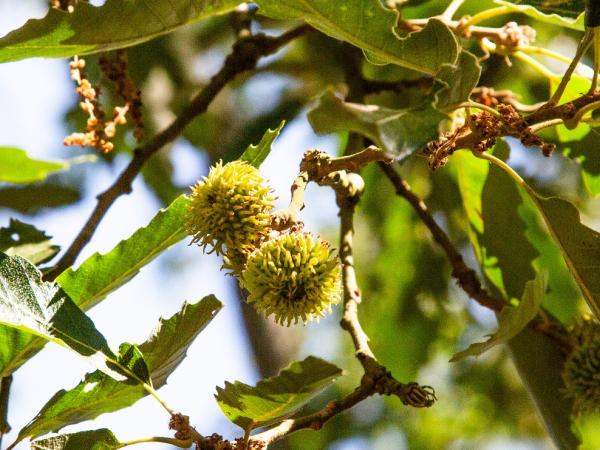
The only oak species endemic to Africa is rare in cultivation. It shouldn't be.
An important and highly consequential paper (McLaughlin et al. 2026) should significantly change our approach to assessing the risk to oaks from climate change. While it is concerned with the endemic and near-endemic oaks of California, the findings of the research should have a much wider application.
Many methods for the assessment of risk to trees, including the globally trusted Red List compiled under the authority of the International Union for the Conservation of Nature, don’t consistently include the risks from habitat loss due to climate change. To address this, the University of California research team, headed by IOS member Dr. Blair McLaughlin, critically reviewed the current literature on threat categorization as it relates to 27 of the state’s foundational endemic and near-endemic trees, including eight oak species plus tanoak. They found that even under the most conservative climate change forecasts, most species qualify for higher Red List threat levels than their current status.
Over the next century, those 27 species are projected to lose over half of their available habitat as a result of likely climate change. For the eight oak species the outlook is even worse, as the bar chart below illustrates.
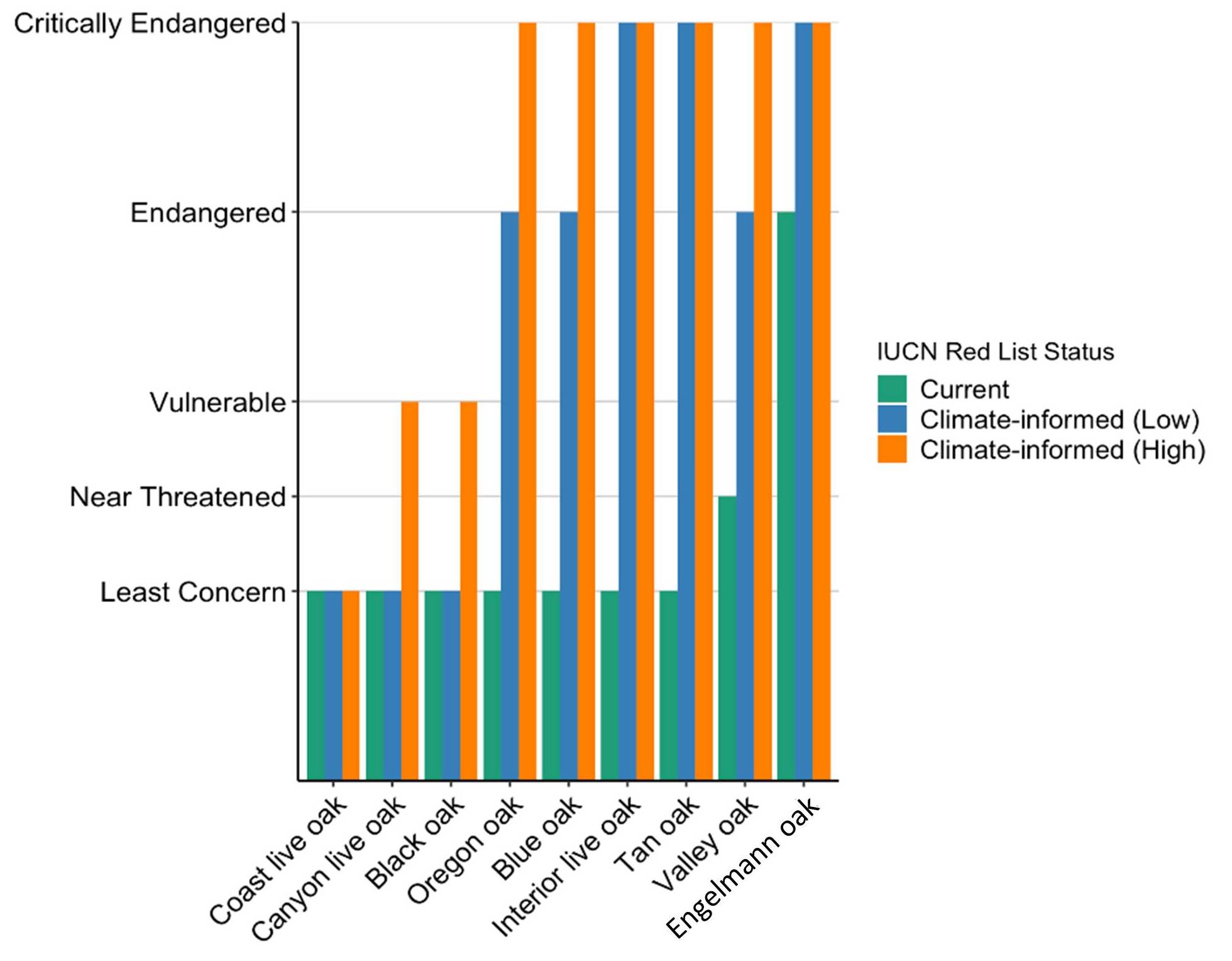
Species currently categorized as Least Concern that jump to Endangered or Critically Endangered status under even the low-loss estimates include Quercus wislizeni (interior live oak), Notholithocarpus densiflorus (tanoak), and Q. douglasii (blue oak). As almost 100 per cent of the distributional ranges of Q. engelmannii (Engelmann oak), Q. lobata (valley oak), Q. wislizeni and Q. douglasii fall within California/Baja California, the prospects for these species in the absence of radical conservation efforts seem bleak.
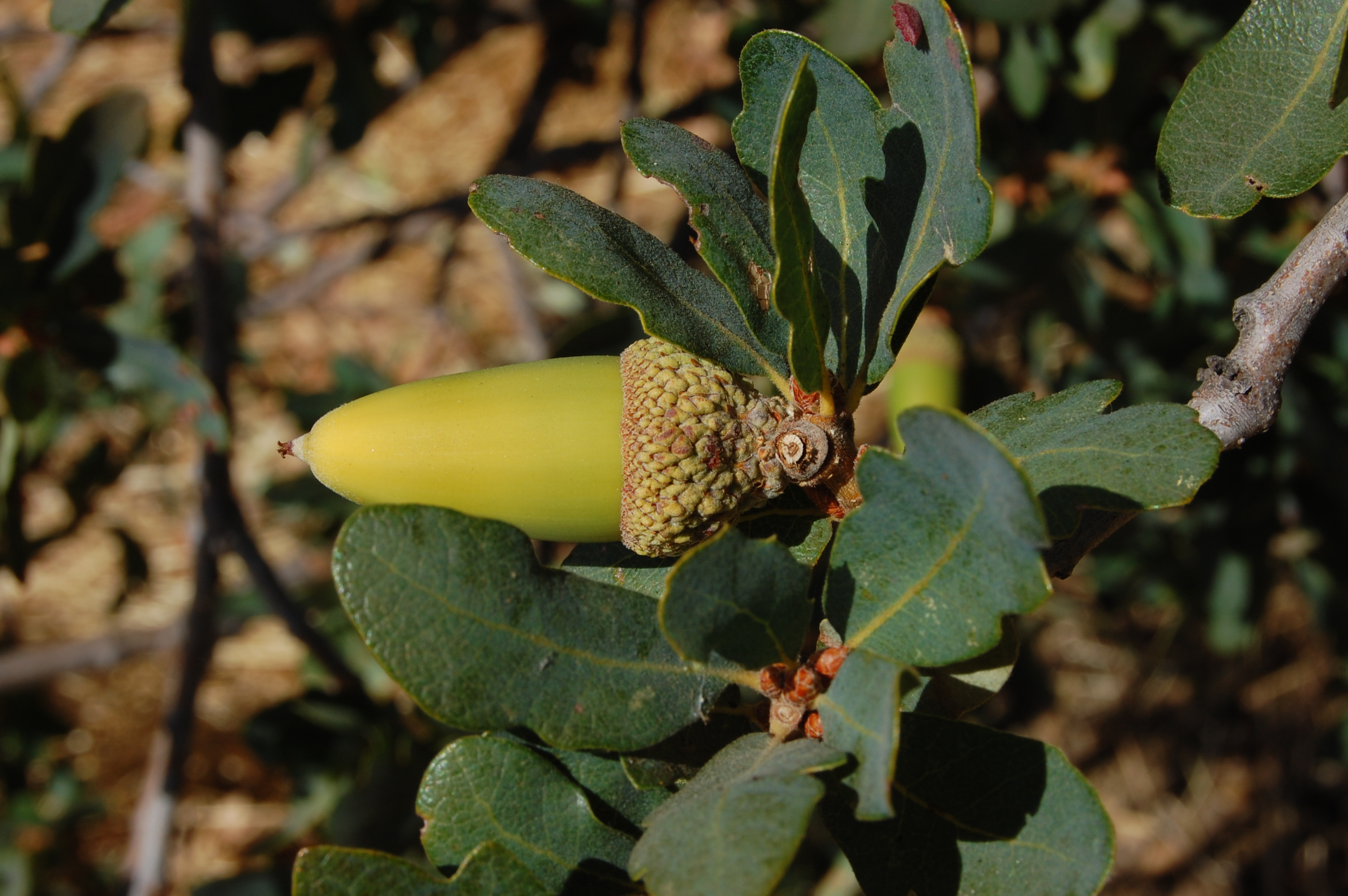
Of course, beyond the loss of the oaks themselves we would also face the loss of their ecosystem services (Wyly 2019) and their cultural value. Taking Q. douglasii as one example, its timber is of relatively low value, but it is greatly appreciated by ranchers for the shade it affords to cattle, and its acorns were formerly and still are an important part of the diet of Indigenous Californian peoples. As Blair points out, “If you lose a blue oak woodland, you’ll generally be left with an invasive grassland.”
It’s notable that, of the eight true oak species featured in the bar chart above, only two (Q. engelmannii and Q. lobata) met the criteria employed in the Conservation Gap Analysis of Native U.S. Oaks (Beckman et al. 2019) to be considered as of high priority for conservation intervention. If the UC research were to be replicated for other US States and for other countries with oak species distributions limited by growing season temperatures and precipitation, there seems little doubt that a significant number of other oak species would qualify for promotion to the IUCN Threatened categories. The often-quoted figure of 31 per cent of the world’s oak species being threatened with extinction may have to be revised upwards significantly: a thoroughly depressing prospect. However, a better understanding of species’ risk and the predicted spatial patterns of loss will help to more strategically and proactively guide conservation efforts.
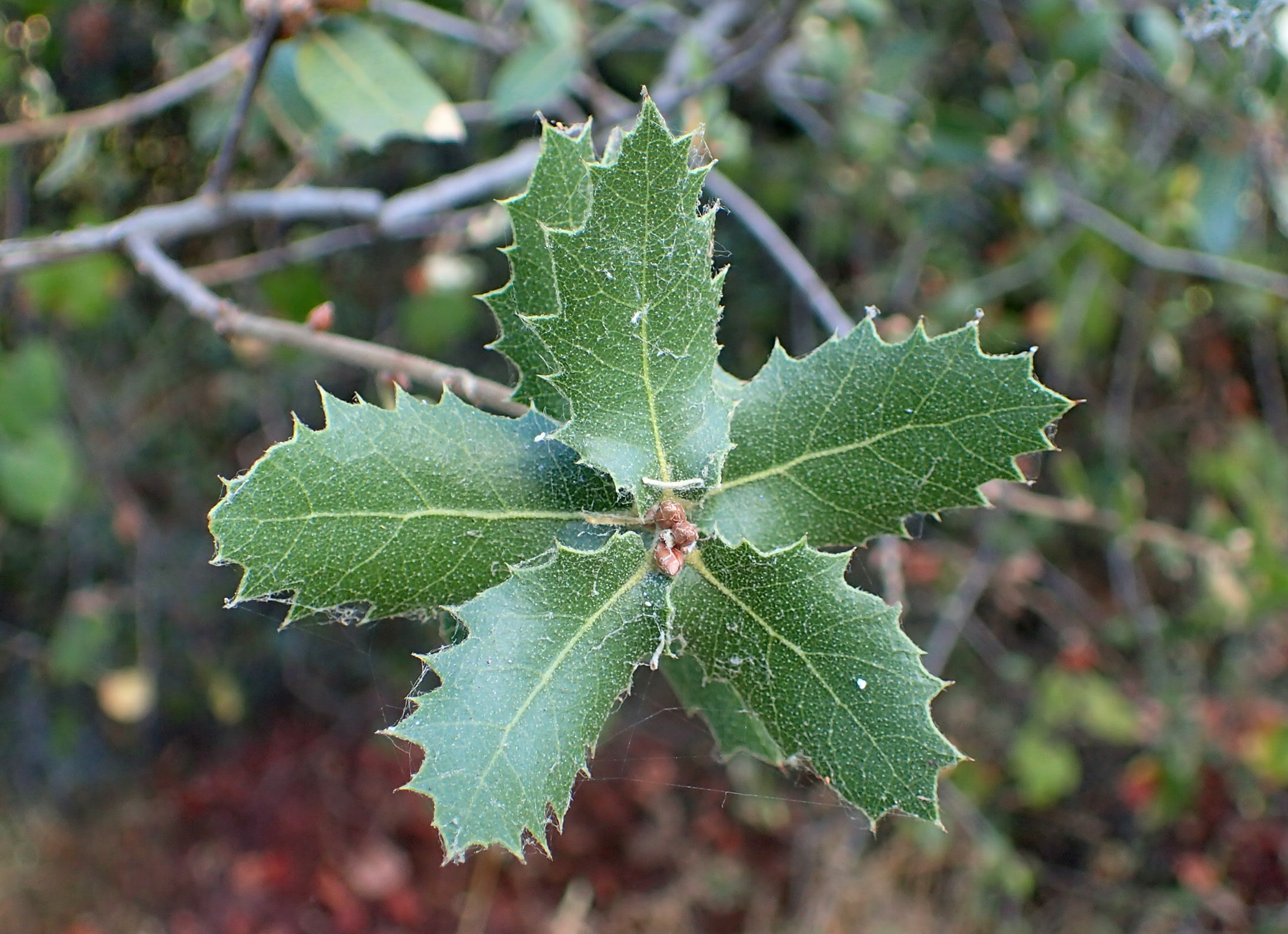
This investigation raises a significant number of questions about our approach to oak conservation in a changing climate. These are questions we would like to address, if possible, in future articles with Blair and with Amy Byrne in her capacity as the manager of the Center for Species Survival: Trees, and the global coordinator for the Global Conservation Consortium for Oak at The Morton Arboretum. Meanwhile you can view Blair’s presentation to the 11th IOS Conference (Session 6, third presentation), below.
Works cited
Beckman, E., A. Meyer, A. Denvir, D. Gill, G. Man, D. Pivorunas, K. Shaw, K., and M. Westwood. 2019. Conservation Gap Analysis of Native U.S. Oaks. Lisle, IL: The Morton Arboretum [link]
McLaughlin, B. C., M. M. Abbott, S. Lipton, D.A. Ackerley, M.B. Rose, H.V. Moeller, and E.S. Zavaleta. 2026. Adapting Species Risk Assessments to a Changing Climate: The Underestimated Vulnerability of Foundational Trees. Global Change Biology 32(4): e70866. [link]
Wyly, Z. 2019. Species Spotlight: Quercus douglasii Hook. & Arn. International Oak Society Website. [link]
Content by the Same Author
The International Oak Society acknowledges the generous support of the following institutions:
Supporting Institutional Members



Standard Institutional Members