Editor's Picks

While working on a list of synonyms of European White Oaks...
Roderick Cameron
|
Aug 24, 2026
Report led by The Morton Arboretum will help prioritize oak...
Website Editor
|
Aug 06, 2026
Motivation
I live in the village of Dolné Dubové...
Jozef Čapkovič
|
Jul 20, 2026
Plant Focus
The only oak species endemic to Africa is rare in cultivation. It shouldn't be.
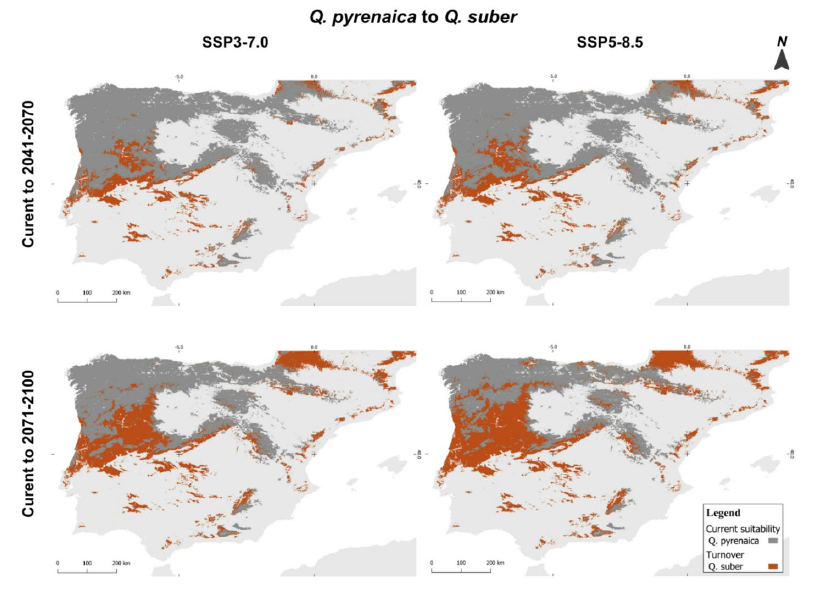
In the last edition of The Cupule we reviewed a paper co-authored by IOS member Elif Deniz Ülker that investigated the likely future range of six European oak species under two climate change scenarios (Ülker and Tavşanoğlu 2026). Now a group of Portuguese researchers including lead author Isabel Passos and IOS member Carlos Vila-Viçosa have modelled the likely range response of three species predominantly associated with acidic substrates—Quercus robur, Q. pyrenaica, and Q. suber—in the Iberian Peninsula under two scenarios, the more pessimistic of which is common to both of these papers (Passos et al. 2026).
The objectives of this study were to:
-
Project future suitable areas in mid (2041–2070) and late 21st century (2071–2100), under intermediate (SSP3-7.0) and pessimistic (SSP5-8.5) climate change scenarios, using ensemble Species Distribution Models
-
Test the likelihood of species turnover among the three focal silicicole1 oaks across the Iberian Peninsula
-
Quantify and map turnover hotspots with areas where the current suitable dominant oak species are likely to be replaced by newly suitable/adapted species
- Explore the potential for species turnover within key conservation sites
-
Provide recommendations to guide forest management, adjust species composition in restoration and plantation programs, and prioritize conservation in sensitive transition zones.
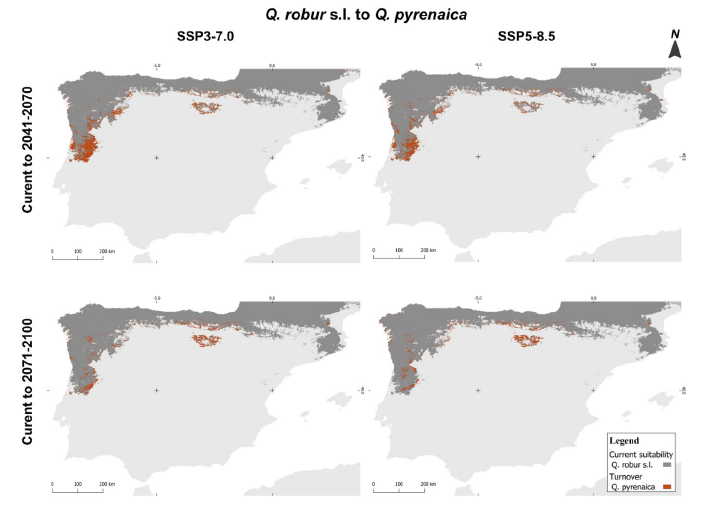
Turnover from <em>Quercus robur s.l.</em> current suitable area for <em>Q. pyrenaica</em> under two climate scenarios (SSP3-7.0 and SSP5-8.5) and two time frames (2041–2070 and 2071–2100)
It’s noteworthy that pedunculate oak is here referenced under the binomial Q. robur sensu lato (s.l.). This is because Vila-Viçosa et al. (2021, 2023) consider that populations of this species in the Iberian Peninsula are morphologically and genetically independent of non-Iberian populations.
The results of this modelling indicate that we should anticipate significant changes to Iberian oak forests, driven by projected climate change. Drought-adapted oaks can be expected to replace moisture-dependent species along existing environmental gradients. Pedunculate oak (Q. robur s.l.) should retain stable populations in cooler, humid regions (in agreement with the findings of the Ülker paper) while Pyrenean oak (Q. pyrenaica) faces major range contractions and local extinctions. In contrast, cork oak (Q. suber) is projected to expand northward and to higher elevations, progressively replacing those species in decline.
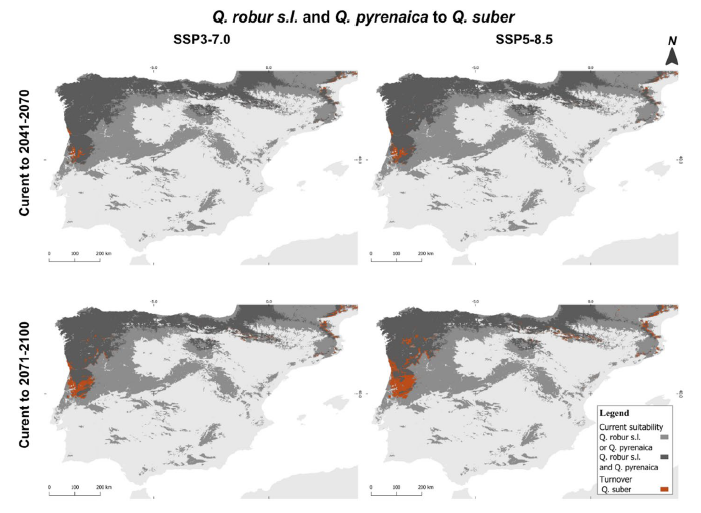
These changes reflect the climate of the Peninsula becoming more Mediterranean, with longer summer dry periods and reduced precipitation throughout the year. Dependent, presumably, on the retention of some habitat connectivity, these processes of species turnover could allow oak forests to maintain their canopy cover and ecological function, but this will require land managers to recognize and facilitate the process. The authors advise that future management of these woodlands should consider climate change projections when preparing restoration and afforestation programs, favoring mixed-species and multi-provenance approaches. “Continued monitoring will be crucial to evaluate the success of these adaptive measures. Embracing species turnover as an opportunity, guided by science-based and flexible management, can help ensure the persistence and resilience of Mediterranean oak forests under a rapidly changing climate.”
Works cited
Passos, I., A., Figueiredo, J. Gonçalves, M.M. Ribeiro, and C. Vila-Viçosa. 2026. Exploring turnover dynamics in Iberian Oak forests under climate change scenarios. Discover Conservation 3: 14. [link]
Ülker, E.D. and Tavşanoğlu, Ç (2026) Oaks and Climate Change: Contrasting Range Responses of Mediterranean and Temperate Quercus Species in the Western Palearctic. Ecology and Evolution 16(2): e73055. [link]
Vila-Viçosa, C., R. Castilho, A. Hipp, F. Vázquez, R. Almeida, C. Garcia, ... and H. Azevedo. 2021. RAD-Seq unveils the phylogenetic backbone of the Iberian white oak (Quercus L. section Quercus) syngameon. Conference: 1st Spanish Botanical Congress, Toledo. [link]
Vila-Viçosa, C.M., J.H. Capelo, P. Alves, R.S. Almeida, and F.M. Vázquez. 2023. New annotated checklist of the Portuguese oaks (Quercus L., Fagaceae). Mediterranean Botany 44: e79286. [link]
1 Oaks that live on soil containing silica. An alternative form is “silicicolous”; the article uses both.
Content by the Same Author
The International Oak Society acknowledges the generous support of the following institutions:
Supporting Institutional Members




Standard Institutional Members