Editor's Picks

While working on a list of synonyms of European White Oaks...
Roderick Cameron
|
Aug 24, 2026
Report led by The Morton Arboretum will help prioritize oak...
Website Editor
|
Aug 06, 2026
Motivation
I live in the village of Dolné Dubové...
Jozef Čapkovič
|
Jul 20, 2026
Plant Focus
The only oak species endemic to Africa is rare in cultivation. It shouldn't be.
The Royal Society for the Protection of Birds (RSPB), which is also the protector of ancient oaks in Sherwood Forest, has today confirmed the death of the iconic Major Oak. It was not unexpected: last year we reported on concerns about the tree’s health and about the efforts to save it, which were heroic but unfortunately too late to be successful. Previous health assessments had not disclosed how seriously stressed the tree was by soil compaction and by successive droughts.
It’s becoming more and more evident that there is more to an oak than a single arboreal plant. It is a community, a genetic mosaic, and a biome of bacteria, fungi, and associated organisms. A total of some 2,300 species are dependent, to a greater or lesser extent, on the two native British oaks (Q. robur and Q. petraea; Mitchell et al. 2019). It’s some consolation, therefore, to be told that there are no plans to fell the tree. It will be allowed to return gradually to the earth, possibly supporting a new range of fungi and saproxylic insects as it does so.
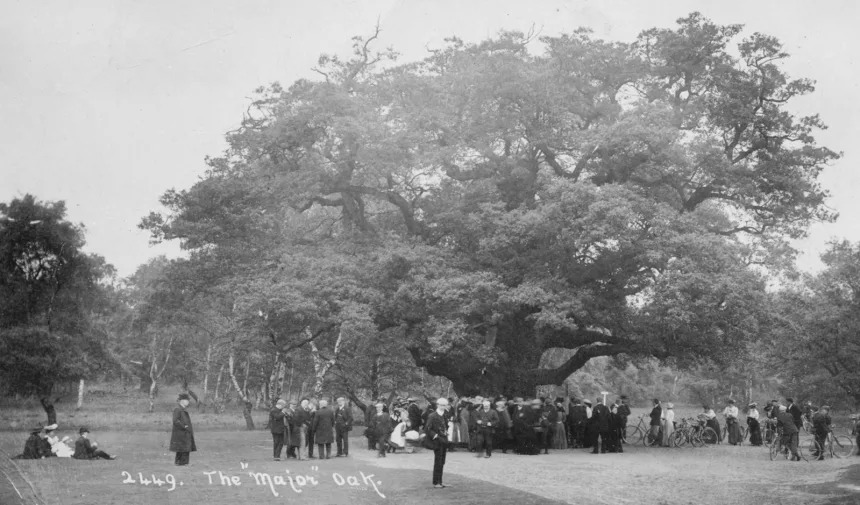
And, of course, its memory will live on. In some respects it has always had a mythic status. It has been claimed over the years to be Britain’s largest and oldest oak, but it was neither of these. Robin Hood and Maid Marian were not married beneath its boughs because they are fictional characters, but who cares? The tree is so much a part of the English identity that when the Olympic flame toured the country on its way to the London Olympics in 2012, it visited the tree, to be met by none other than Robin of Locksley and his consort. There is a further sense in which its legacy will live on, as the lessons learned from the attempts to save it will be put to work to help conserve Britain’s considerable stock of surviving ancient and veteran oaks.
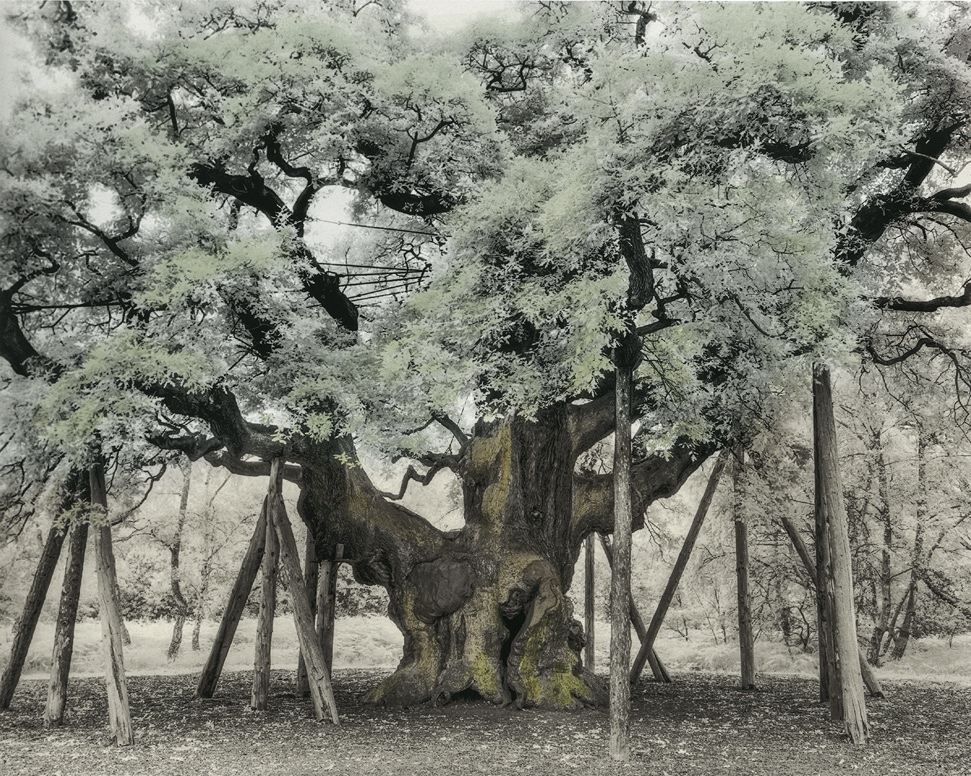
Meanwhile, we can enjoy Beth Moon’s celebration of the tree’s genius loci, from healthier times.
More information is available on the RSPB website here.
Works cited
Mitchell, R.J., P.E. Bellamy, C.J. Ellis, R.L. Hewison, N.G. Hodgetts, G.R. Iason, … and A.F.S. Taylor. 2019. OakEcol: A database of Oak-associated biodiversity within the UK. Data in Brief 25: 104120. [link]
Content by the Same Author
The International Oak Society acknowledges the generous support of the following institutions:
Supporting Institutional Members



Standard Institutional Members