Editor's Picks

While working on a list of synonyms of European White Oaks...
Roderick Cameron
|
Aug 24, 2026
Report led by The Morton Arboretum will help prioritize oak...
Website Editor
|
Aug 06, 2026
Motivation
I live in the village of Dolné Dubové...
Jozef Čapkovič
|
Jul 20, 2026
Plant Focus
The only oak species endemic to Africa is rare in cultivation. It shouldn't be.
Background & Preparation
In this turbulent time, we set out for a two‑week vacation in Cyprus. We rented a comfortable, spacious apartment for the duration at a tourist site located between Limassol and Paphos. Our intention was to explore the nature of the high Troodos Mountains and the Paphos Forest, both by foot and by car. Preparation involved scouring the internet for sites, hiking trails, and specific oak trees, supplemented by suggestions from an Israeli friend and my local acquaintance, Nikos Soteriou.
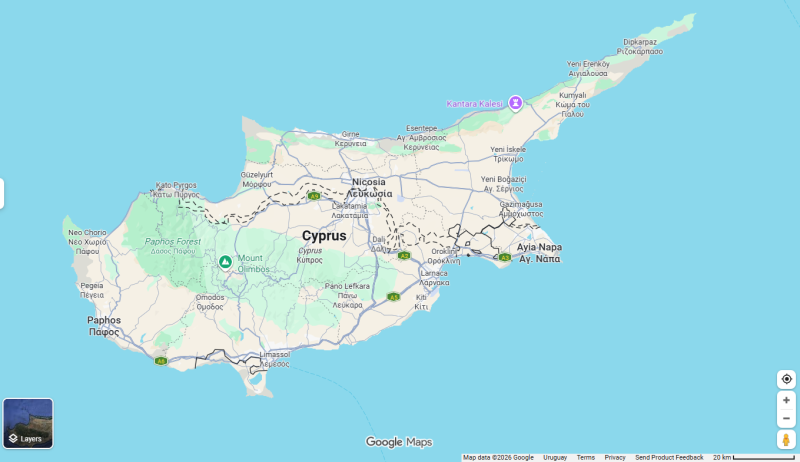
We relied on Google Maps, Maps.me, and AllTrails for navigation. I also used the Israel Oak Registry (IOR) GIS map to record oaks encountered on the trip. (You can learn more about the map below.)
The island is a small place, even relative to Israel, making it possible to reach any site within our planned area in a 60-to-90-minute drive. We equipped ourselves with backpacks, water, and sandwiches for our hikes. Generally, there is no need to worry about food, as villages with restaurants and/or shops where one can restock are ubiquitous. The weather during this time of year (late April to early May) was very pleasant, which enhanced the experience of touring and hiking.
Ahead of our trip, I was in touch with my friend Nikos Soteriou. He knows that I'm crazy about oaks and prepared accordingly. The first route Nikos joined us for was the impressive Kalidonia Trail—a circular route on the southern slopes of the Troodos peak, beginning at Troodos Square.
This is an area of forest (perhaps primordial?), dominated by magnificent black pine (Pinus nigra subsp. pallasiana) and foetid juniper (Juniperus foetidissima). One can also see the Cyprus cedar (Cedrus brevifolia), which was planted by the Cyprus Forestry Department.
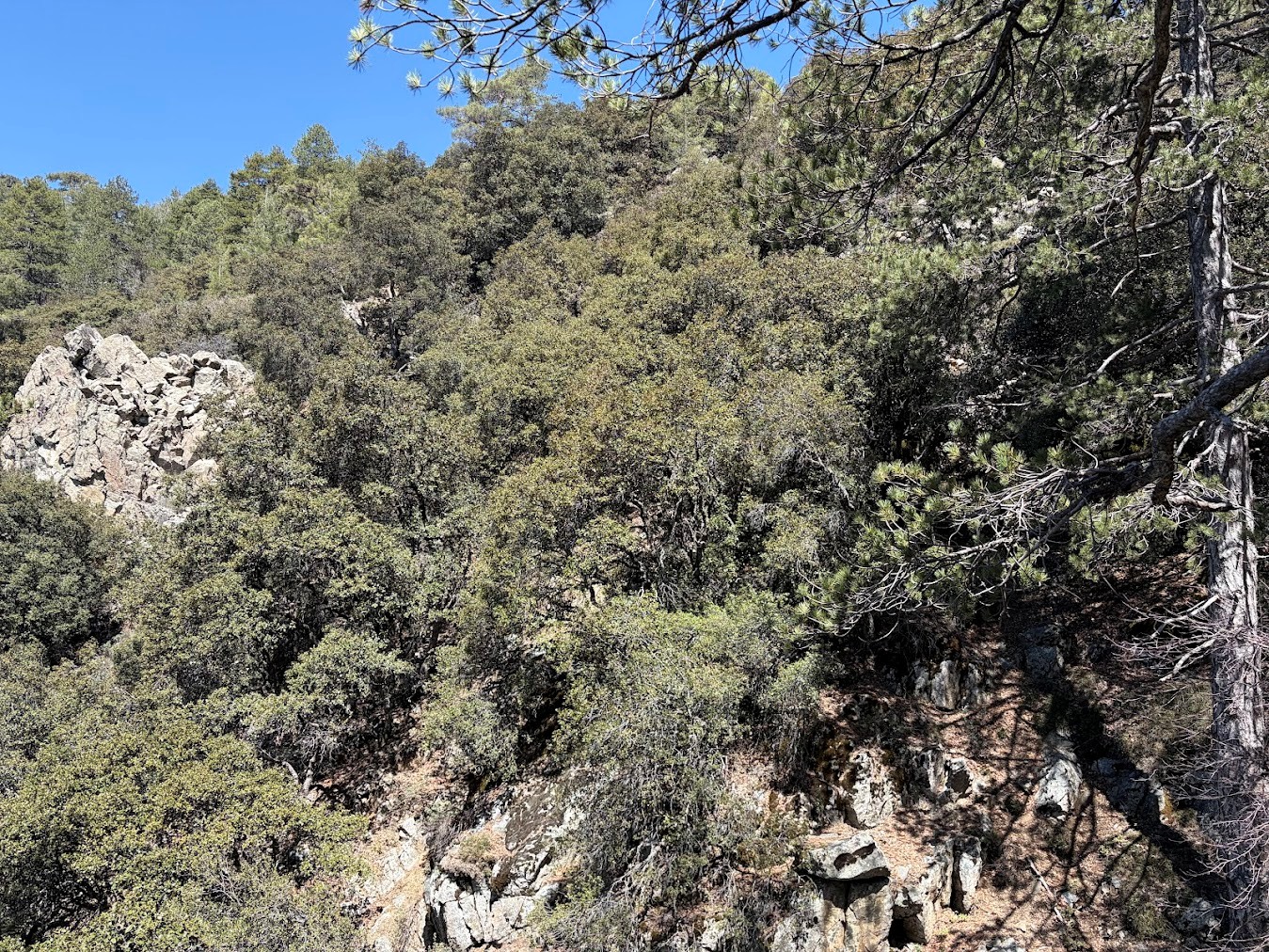
As you descend in altitude along the trail, reaching elevations below 1,600 meters, the terrain becomes covered with small, multi-stemmed shrubby trees. This is the golden oak (Quercus alnifolia), a tree endemic to Cyprus. While there is a variety of pines, junipers, and shrubs, here this oak is dominant.
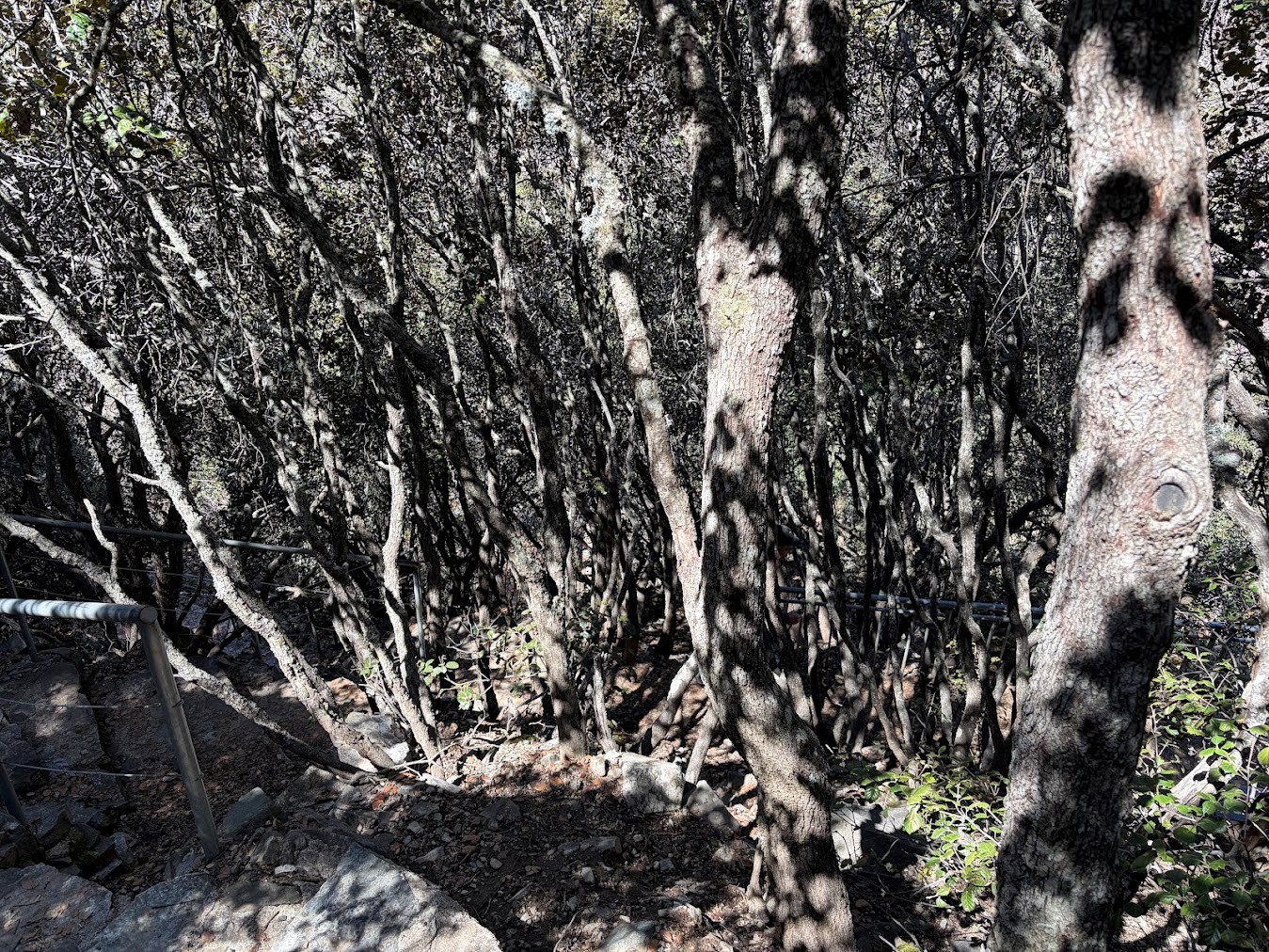
Another route that was warmly recommended to us is the Cedar Valley Trail. The drive to the Cedar Valley is long and tiring, on a winding road that must be driven at low speed. But we will be greeted by breathtaking views of high mountain ranges and deep valleys with pine forests and golden oak trees. After a long drive, we arrive at the coveted valley.
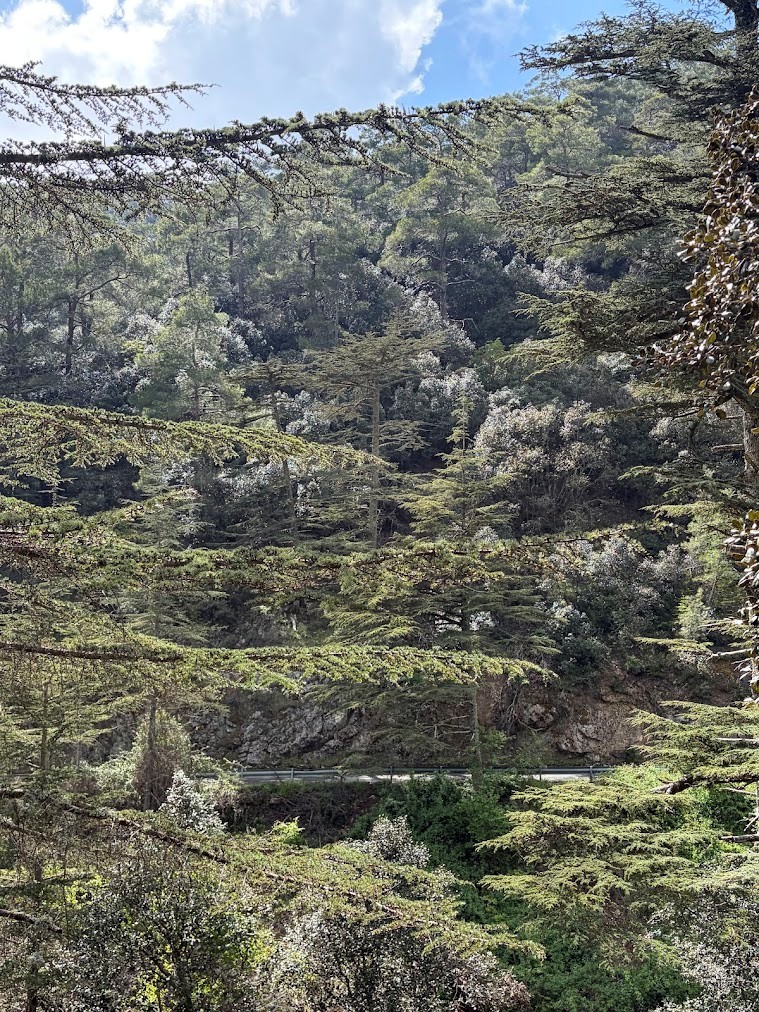
The variety of trees in the Paphos Forest and Cedar Valley includes, mostly, the Brutia pine (Pinus brutia), Greek strawberry tree (Arbutus andrachne), terebinth (Pistacia terebinthus), azarole hawthorn (Crataegus azarolus), Syrian or Cyprus maple (Acer obtusifolium), and the golden oak (Quercus alnifolia), which is very widespread.
The tree for which the place is named is the Cyprus cedar (Cedrus brevifolia), a tall and most impressive tree, endemic to Cyprus and growing almost exclusively in this part of the forest. We were disheartened to discover that many of the large trees have dried up and died, and many others are in a state of advanced decline. While there are still vital trees, the general impression is that the younger trees appear more resilient than the larger ones.
In a general (and personal) view, given the contrast between the beauty and uniqueness of the site and the visible decline and overall impression it leaves, the long and winding drive is not justified—unless you have a very specific interest in plants and forestry.
Famous oaks
In preparation for the tour, I tried to locate large oak trees that had gained fame online or on social networks. On my shortlist were three famous large oaks of the species Cyprus oak (Quercus infectoria subsp. veneris)1 known also as Aleppo oak.
- The Lania Oak
- The Fyti Oak
- The Oak of Aphrodite and Adonis
The three famous oaks appear in various places across the internet and on Google Maps, and they are described below.
Regarding other oaks of different species, I had no prior information or idea of what to expect, except for a list that included three species: Q. alnifolia, Q. infectoria subsp. veneris, and Q.coccifera (Kermes Oak).2
Following them are some of the oaks we encountered by surprise. A small number of specimens were added to the list where it was possible to stop and dedicate time to recording them. Due to the limited time at my disposal, I focused only on large and particularly impressive specimens.
Aphrodite & Adonis oak
The Oak of Aphrodite and Adonis is a massive Q. infectoria subsp. veneris. It has a diameter of 201 cm and a canopy spread of 28 meters. The oak is located at the fork of two trails: the Aphrodite trail and the Adonis trail, which is the source of its name. A specimen in perfect shape, it stands solitary in an area of Mediterranean scrubland. Its branches are fully intact, and it displays excellent vitality. This is the most impressive oak I encountered in Cyprus.

While walking along the Adonis Trail, we came across a large and impressive Q. coccifera (designated as CAL2504262 in the Israel Oak Registry). It has a diameter of 97 cm and a canopy spread of 15 meters, with a very impressive main trunk. Throughout the island, this was the first and only instance of a massive Kermes oak that we encountered. Other oaks of this species were small, with a small tree-like or shrubby appearance similar to Q. alnifolia; therefore, no other oaks of this species were recorded on the map.
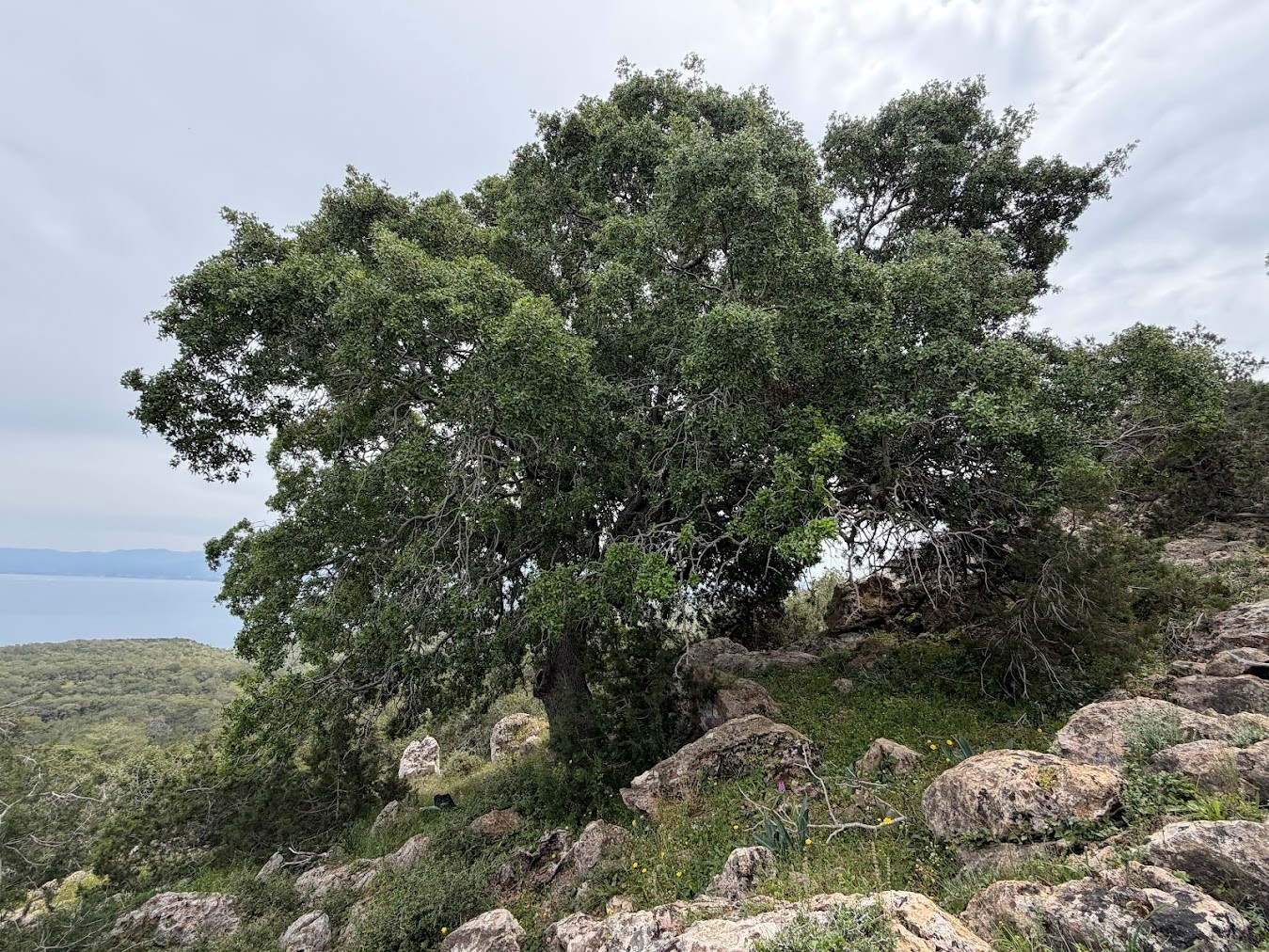
Fyti oak
The Fyti oak is an ancient oak, with an extremely impressive trunk measuring 280 cm in diameter. In a state of decline and hollow. Most of its branches are either broken or have been lopped off.
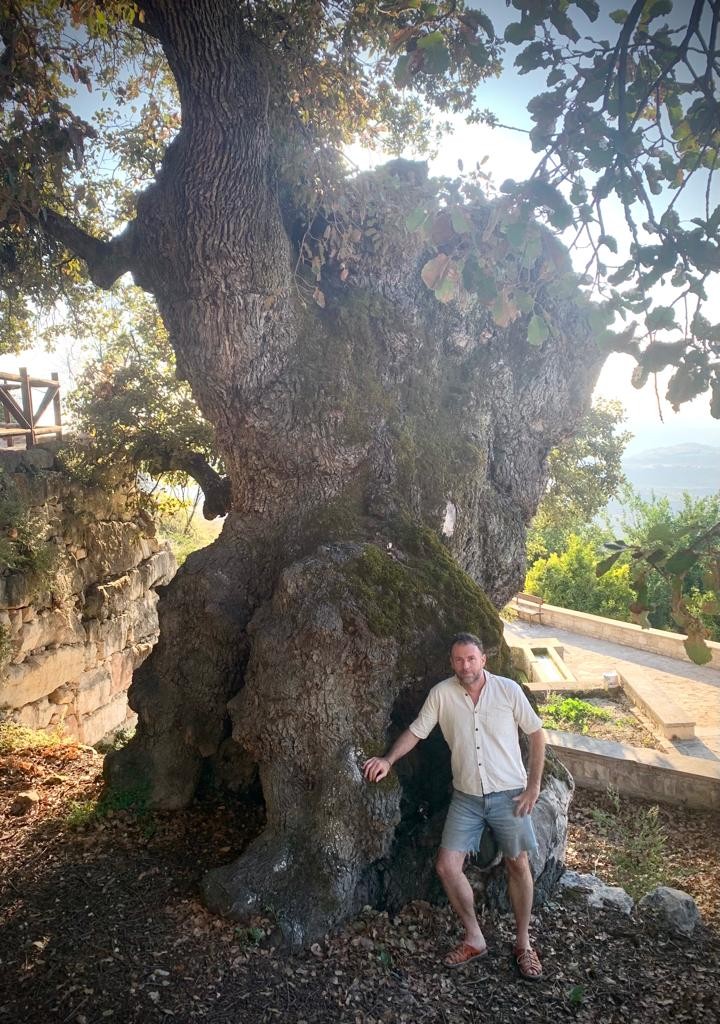
Lania oak
The Lania Oak is a massive Cyprus oak with a trunk diameter of 270 cm. (I missed this oak on this journey.)
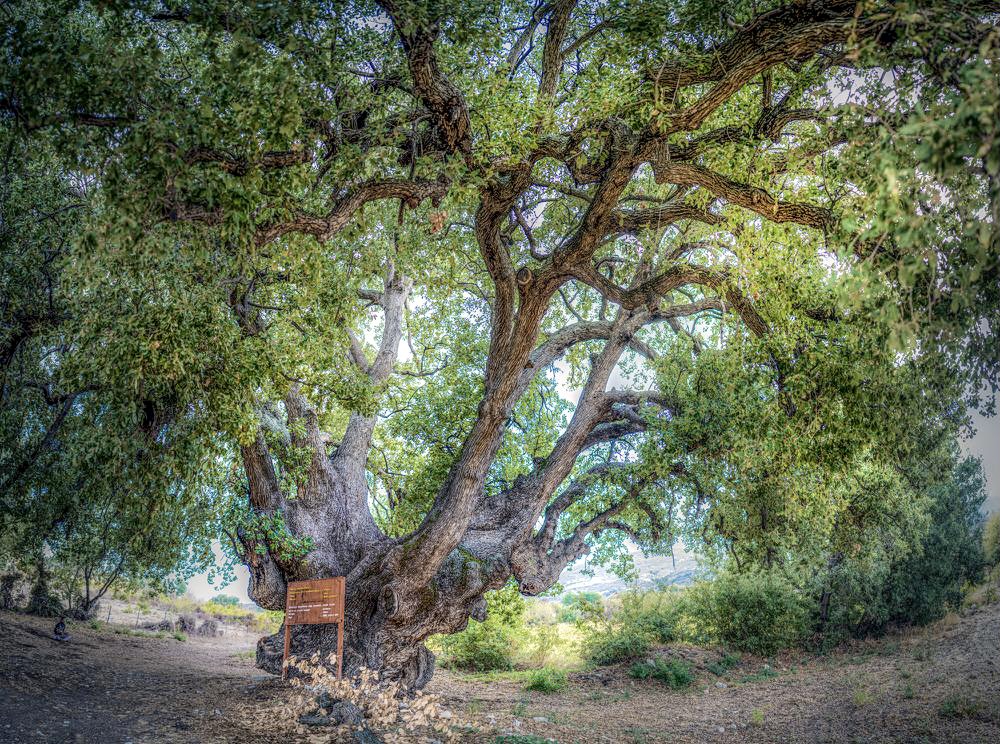
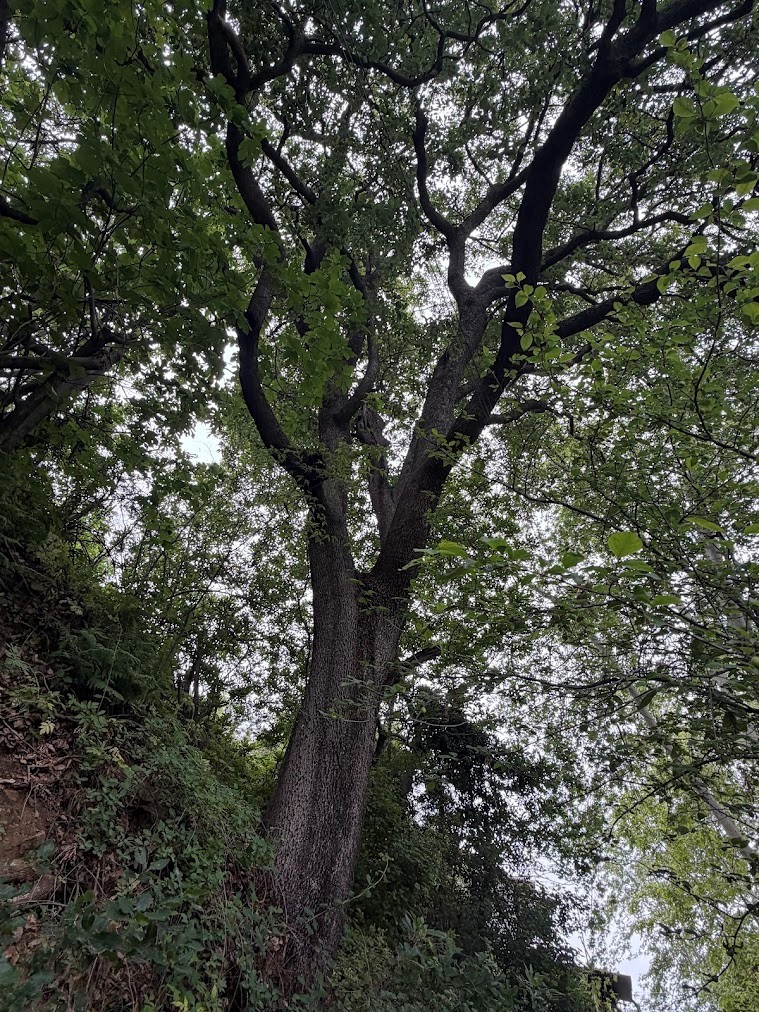
At the beginning of our excursions, while travelling north of Paphos we were looking for a trail and gambling on finding an interesting site. The area consisted of a ridge slope with lush vegetation and well-developed Mediterranean woodland. A large oak tree within the forest caught my attention. As I approached it, it indeed turned out to be a large Cyprus oak—alive, but declining and hollow. The trunk diameter of this oak is 120 cm. The tree is registered on the IOR map with the designation INF2104261 and can be located by clicking on the image.
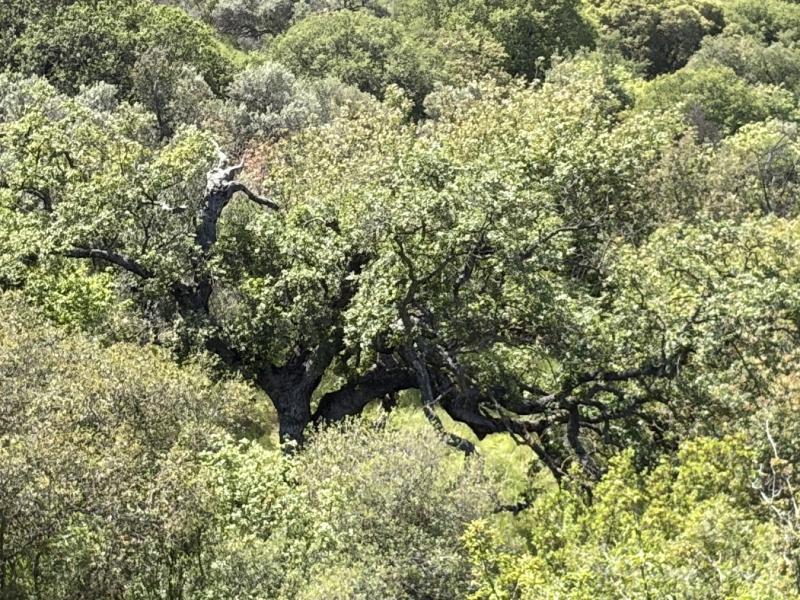
Our first surprise awaited us in Pera Pedi (Πέρα Πεδί). Nikos pulled the car over next to a tree that made my heart skip a beat. While it wasn't one of the giants, it was a perfect specimen—with a diameter of 80 cm and a canopy spread of over 15 meters, reaching a height of more than 20 meters. In Israel it is hard to find oak specimens with such an impressive appearance. This was just a preview of the oaks we would encounter further down the road.
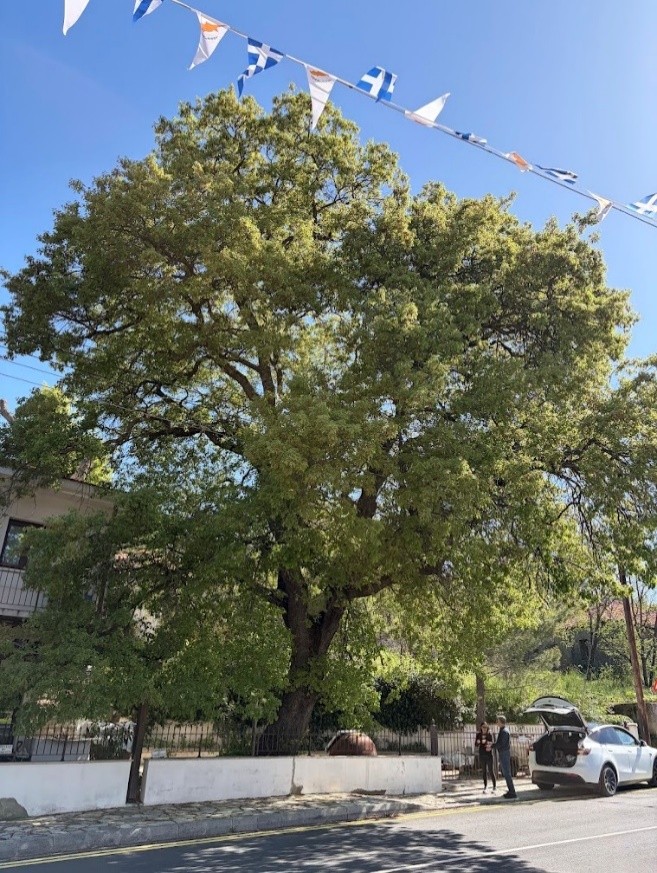
Nikos prepared the next surprise for us in Pano Platres (Πάνω Πλάτρες). At the end of an alley on the edge of a plot, stands a giant Cyprus oak with a trunk circumference of 505 cm, which prompted me to give it the nickname Cyprus 505 on the IOR map. The oak has a diameter of 160 cm, a canopy spread of 30 meters, and an estimated height of over 25 meters. A perfectly vital oak, showing no signs of breakage or any form of decline.
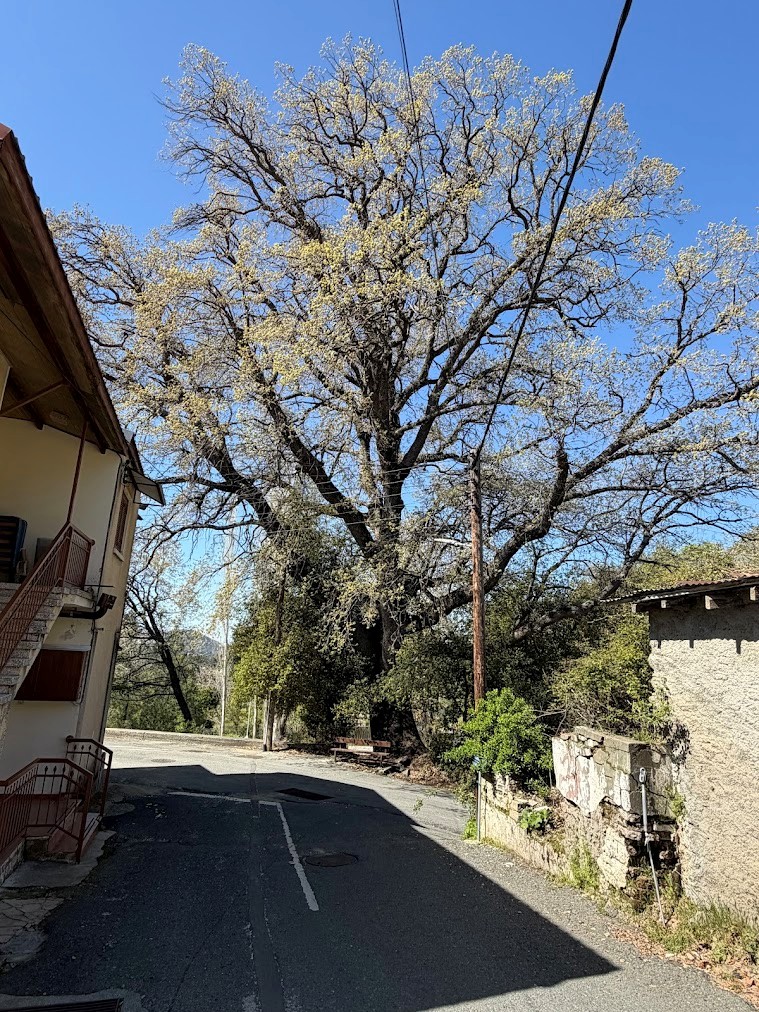
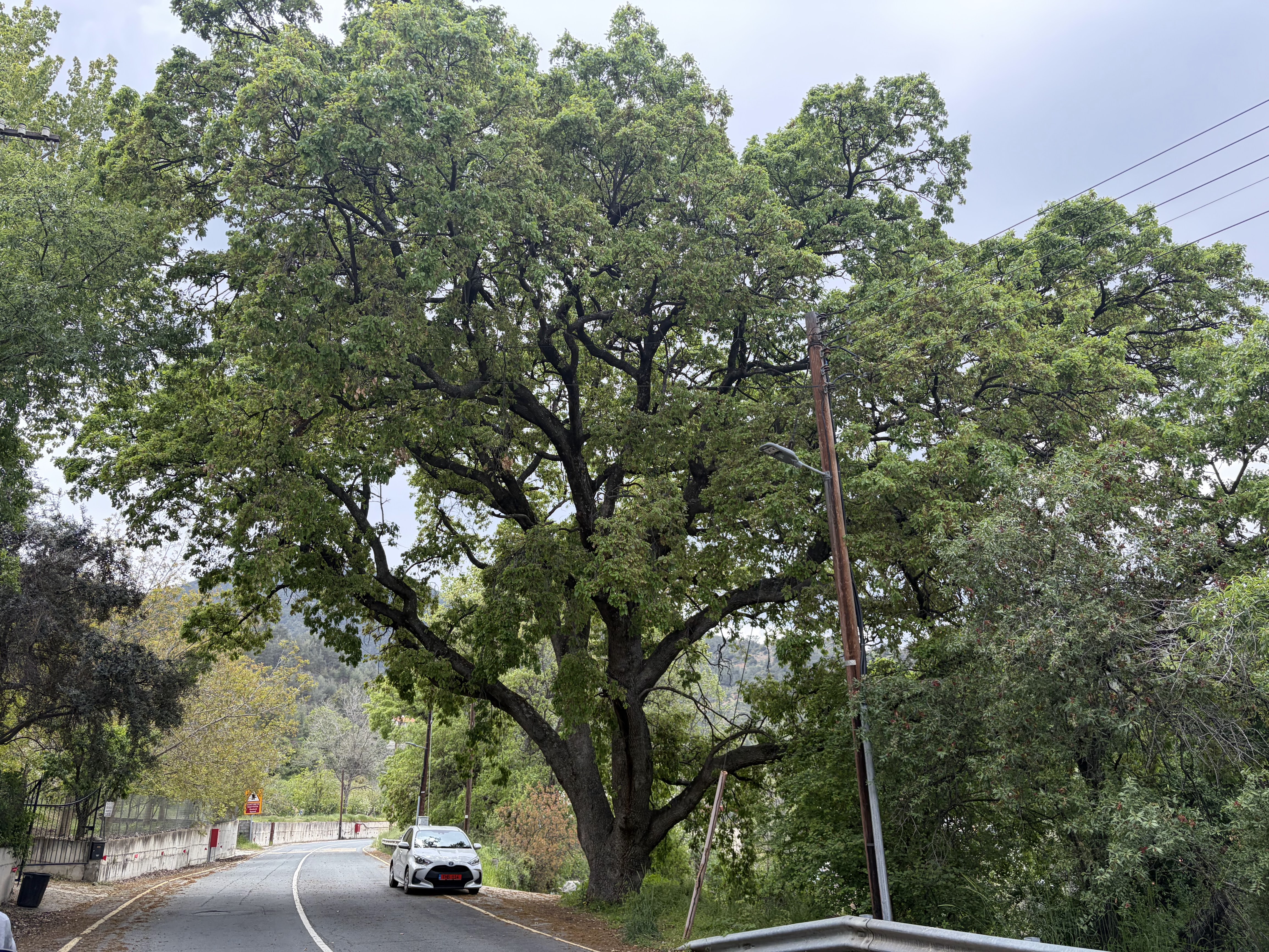
From here, it was quite clear to me that the Cyprus oaks have a powerful and impressive presence. Our subsequent tours did not disappoint. A drive along the E802 road in Pera Pedi (Πέρα Πεδί) brought us to a massive Cyprus oak, designated as INF2604261 on the IOR map, with a diameter of 142 cm and a canopy spread of 25 meters.
Driving along the E804 road between Platres (Πλάτρες) and Prodromos (Πρόδρομος), we discovered a spectacular scenic route in the area of the Trooditissa (Τροοδίτισσα) riverbed. There is a significant presence of Q. alnifolia in this region. We encountered a specimen with a single trunk—an uncommon growth habit for this species.

During our tour of the village of Kalopanagiotis (Καλοπαναγιώτης), we set out on the Marathasa Trail 1 along the Setrachos River. In this area, the trees seem to grow on steroids! Within the flowing riverbed, there is an abundance of trees, including giant plane trees (Platanus orientalis). Along the trail we encountered magnificent specimens of particularly tall Cyprus oaks, reaching heights of over 20 meters.
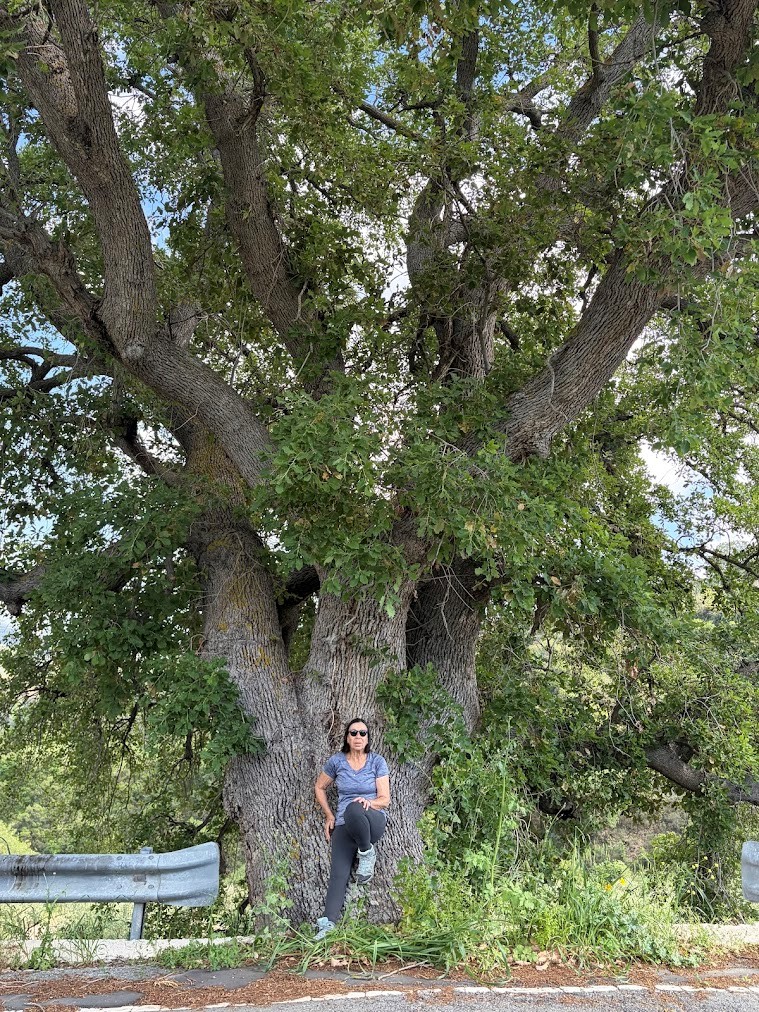
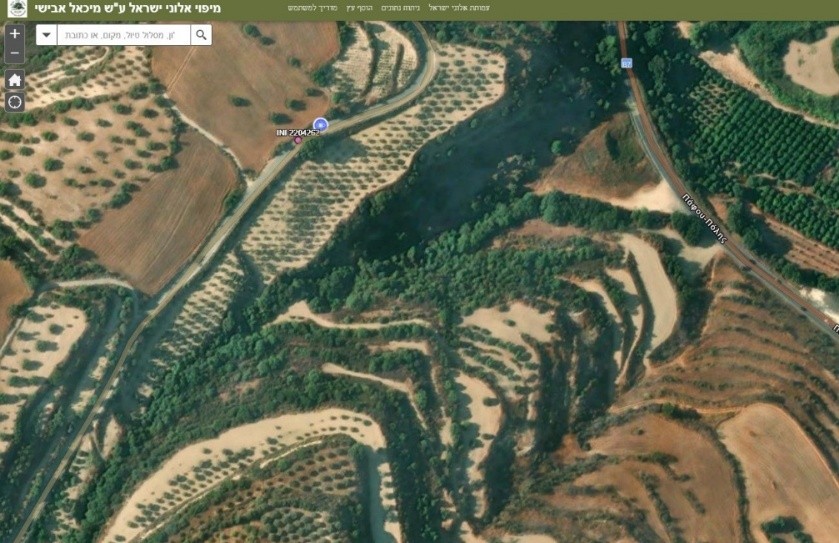
Driving on the F734 road, north of Kato Akourdaleia (Ακουρδάλεια) , we encountered a large and impressive Cyprus Oak, (INF2204262 on the IOR map), right by the road. It has a trunk diameter of 139 cm and a canopy spread of 25 meters.
Forest regeneration
Human settlement in Cyprus dates back to the Paleolithic period (about 11,000 years ago). This is more than enough time for human activity to clear and eradicate most of the natural woodland. With the exception of the high peaks of the Troodos massif, we did not locate any primeval forest. 18% of the island's area is defined as woodland, while 31% of the area at altitudes above 1,000 meters is covered by natural forest.
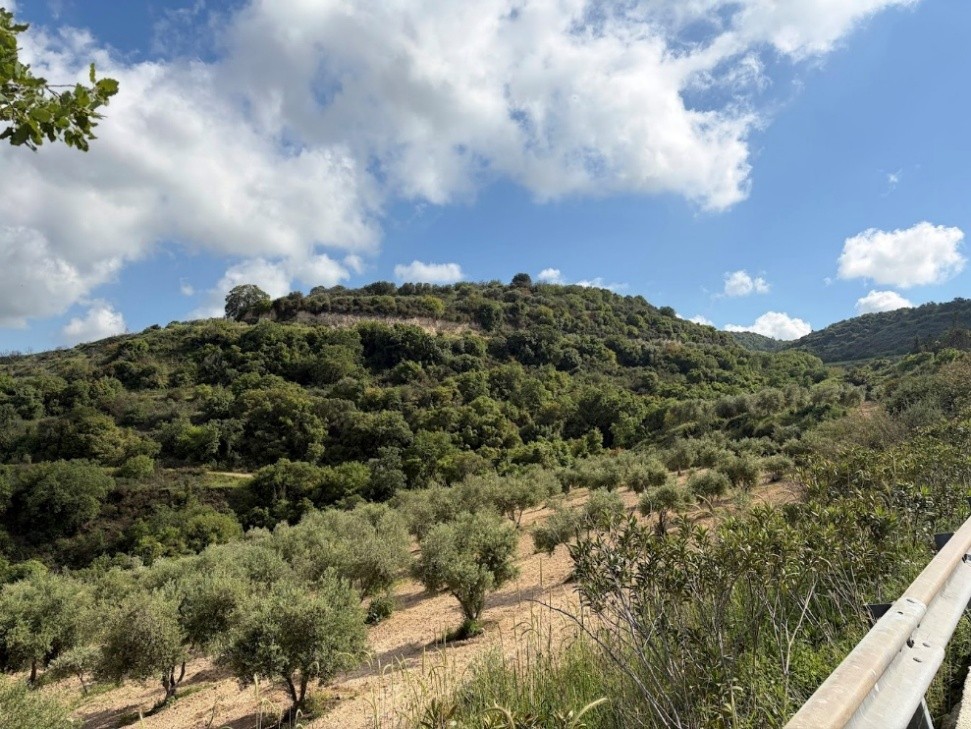
In many of the areas we toured, there are cultivated lands adjacent to abandoned ones. Due to the topographical structure, there is an abundance of terraces from various periods, many of which are now deserted. Depending on the rock formation, soil, and microclimate, a recurring forest phenomenon is evident (particularly in the Troodos massif and Paphos Forest), with Q. infectoria subsp. veneris being a major dominant species.
Insights
Our tour of Cyprus was very brief. To provide a truly comprehensive description, a vegetation and oak survey, would require significantly more time.
- The name of the island has given rise to several terms. One of them is “copper”. The island's name in Ancient Greek was Kypros (Κύπρος). The Romans, who sourced the metal from the island, called it aes Cyprium, meaning “metal from Cyprus”. Later, the name of the metal stabilized as Cuprum. The name of the Cypress tree (Cupressus sempervirens) also derives from this root. And last but not least: one of the common names for the local oak Q. infectoria subsp. veneris is the Cyprus oak.3
- Ancient trees of Cyprus are said to be many centuries old. There is no scientific documentation based on measurements or reliable historical evidence to corroborate these extreme ages. Nevertheless, it is clear that these large trees have a long history; they are usually in a state of decline, with hollow, broken, or truncated trunks.
- Are these exceptionally large trees natural or planted? Did they reach these dimensions naturally, or is it because they are associated with religious or folk rituals that protected and nurtured them?
- Throughout the tour and according to online data, there are only three ancient oak trees in Cyprus with a trunk diameter approaching or exceeding 200 cm. However, there is extensive spontaneous growth and a regeneration/return of natural woodland dominated by the Cyprus oak, which reaches highly impressive dimensions: trunks over 100 cm in diameter, canopy spreads of 20–30 meters, and heights nearing 30 meters. It is interesting to observe the forest regeneration in abandoned plots—the scale of the phenomenon, the history and timing of abandonment and regrowth, and, of course, the growth rate of the young trees.
- The Cyprus oak here is known in Hebrew as Alon Tola and the accepted scientific name is Q. infectoria ssp. veneris. It is clear to the observer that, despite the resemblance, this local species is a variation of the Israeli Alon Tola (Boissier oak), referred to in literature as Q. boissieri, which does not reach the dimensions of the Cypriot species.
- Eike Jablonski claims in his 2013 article “Oaks of Cyprus” that the island is rich in large ancient oaks: “In Cyprus many old, giant trees of [Q. infectoria subsp. veneris] are found." I identified only three such large ancient specimens. Should there be others, I would be happy to receive information about them.
- Jablonski also claims that the Cyprus oak does not quickly regenerate due to the absence in the lowlands of the Eurasian Jays (Garrulus glandarius) on the island. My observations show that the oak reproduces and thrives along roadsides, plot boundaries, and abandoned terraces. Online information indicates that a local variant of the jay, the Cyprus Jay (Garrulus glandarius glaszneri), is common on the island. It, along with mammals, likely assists in the successful dispersal of the Cyprus oak.
- During this tour, I registered 19 oaks, 4 scenic viewpoints, and 1 hiking trail. It would be good if local and international nature enthusiasts were to rise up and join the effort to register more oak trees.
-
The Cypriots possess an abundance of large, spectacular, and noble forest trees:
- Black pine – Pinus nigra
- Foetid juniper – Juniperus foetidissima
- Cyprus cedar – Cedrus brevifolia
- Cyprus oak – Quercus infectoria subsp. veneris
Each of these trees displays a majestic presence. Why, then, did the Cypriots choose the Q. alnifolia as their national tree? A small, shrub-like tree—reminiscent of Jotham's Parable, where the trees crown the bramble as their king. I, of course, would have chosen the Cyprus oak as the national tree of the island.
Appendix: The Israel Oak Registry
Since I am an oak professional and an oak public activist, a platform for registering oaks was particularly important. For this purpose, I created the Israel Oak Registry (pronounced Mipuy aloney Israel in Hebrew). This map can be accessed via this link: https://tinyurl.com/IORegistry. Since the Israel Oak Registry application uses a GIS map, oaks from anywhere in the world, including Cyprus, can be registered on the map. The map is written in Hebrew and opens centered on the State of Israel. To scroll across the map and see additional regions, you need to change the background map (by clicking the icon of 4 squares on the top banner) and select the Open Street Map option. For non-Hebrew speakers, the map can be translated into various languages using a browser, although the translation is not precise and sometimes distorts the correct meaning of the words.
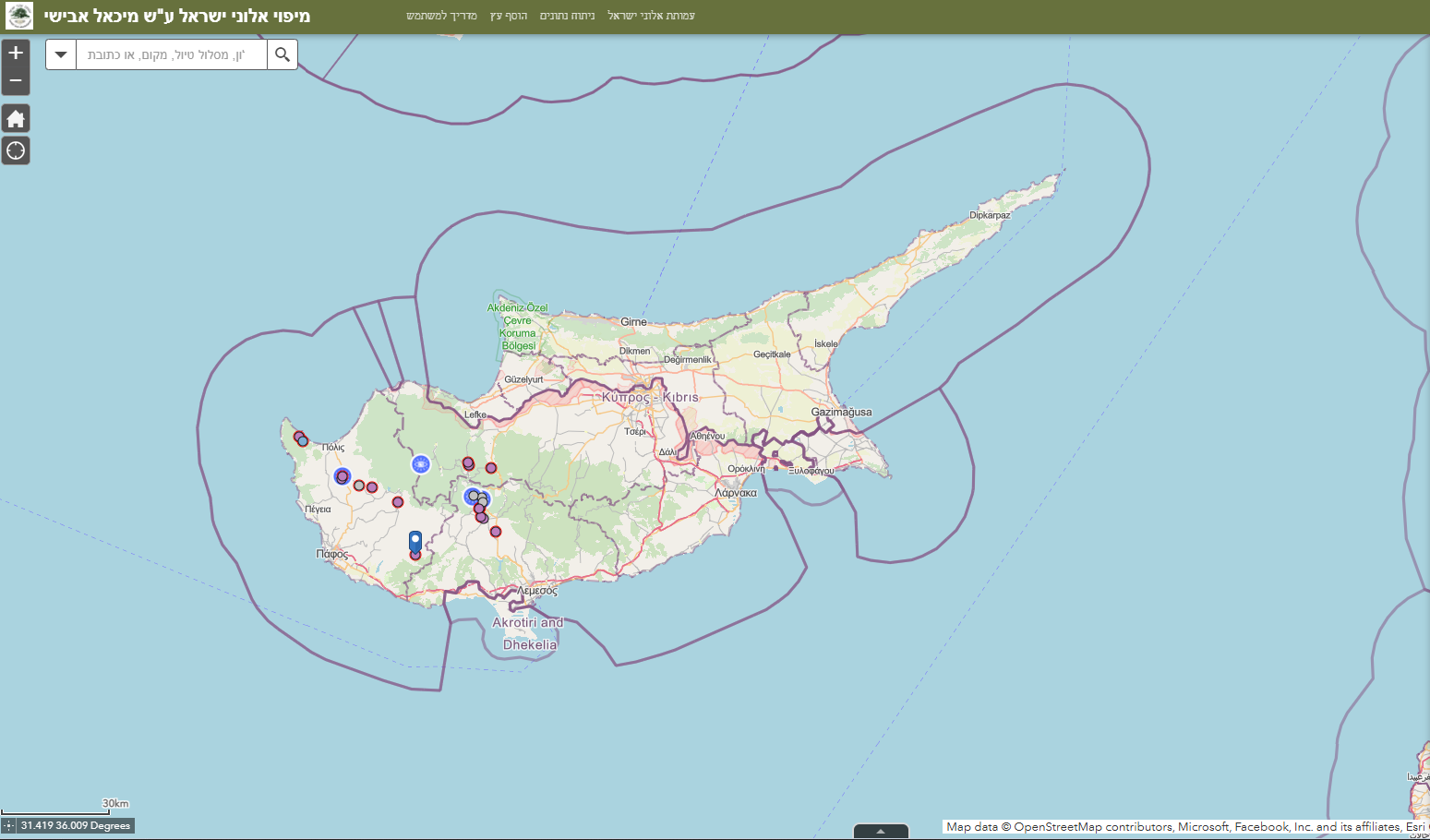
This is a GIS map developed for the registration of oak trees in Israel with a diameter exceeding 50 cm. The system was developed using Esri software, and it allows for the registration of oak trees (as well as other species) anywhere on the planet. In addition to registering trees, the map can be used to plot hiking trails, scenic viewpoints, forested areas, and more. Anyone traveling with a smartphone can use the software to add trees to the spatial database.
1 In Israel, this species is known as Q. boissieri, named after the philosopher and botanist Edmond Boissier. There is an ongoing debate among taxonomists as to whether these are the same species or if they are distinct species or subspecies.
2 In Israel, this oak is known as Q. calliprinos. Here too there is an ongoing debate among taxonomists as to whether these are the same species or if they are distinct species or subspecies.
3 The epithet veneris means “of Venus”, and is often used to designate plants native to Cyprus, the birthplace of Venus. According to classical mythology, Venus (the Roman goddess of love and beauty, known as Aphrodite in Greek mythology) was born from the white foam of the sea. After emerging from the water, she arrived on the shores of Paphos (Πάφος) on the island of Cyprus. In English, the better-known term is “venereal”, which derives from Venus’s association with amatory pursuits, but has no connection to Cyprus!
Content by the Same Author
The International Oak Society acknowledges the generous support of the following institutions:
Supporting Institutional Members



Standard Institutional Members