Editor's Picks

While working on a list of synonyms of European White Oaks...
Roderick Cameron
|
Aug 24, 2026
Report led by The Morton Arboretum will help prioritize oak...
Website Editor
|
Aug 06, 2026
Motivation
I live in the village of Dolné Dubové...
Jozef Čapkovič
|
Jul 20, 2026
Plant Focus
The only oak species endemic to Africa is rare in cultivation. It shouldn't be.
Parisa Panahi1 and Mehdi Pourhashemi2
1 National Botanical Garden of Iran, Botany Research Division, Research Institute of Forests and Rangelands, Agricultural Research, Education and Extension Organization (AREEO), Tehran, Iran
2 Forest Research Division, Research Institute of Forests and Rangelands, Agricultural Research, Education and Extension Organization (AREEO), Tehran, Iran
Introduction
Quercus is the most diverse genus of Fagaceae in Iran. Different species of oak are distributed in vast areas of the Zagros, Arasbaran, and Hyrcanian forests. The Hyrcanian forests, located in the north of Iran, are a green belt stretching over the northern slopes of the Alborz Mountain ranges and covering the southern coast of the Caspian Sea. This area covers 1.85 million ha and comprises 15% of Iranian forests. The Arasbaran forests occupy an area of 160,000 ha in the northwest of Iran. The Zagros forests, spanning an impressive area of over five million hectares, are recognized as the largest forest ecosystem in Iran. The dominant genus in the Zagros forests is oak, with a diverse range of species spread across the area (Sagheb Talebi et al. 2014).
Taxonomy
The taxa in the Q. brantii Lindl. complex are the main species of the Zagros forests. The delimitation of taxa within the Q. brantii complex varies according to different authors (Parsa 1949; Bobek 1951; Djavanchir-Khoie 1967; Menitsky 1971). These authors have focused on leaf and acorn morphology in the recognition of taxa.
According to Parsa in Flore de l’Iran (1949), two species, Q. brantii and Q. persica Jaub. & Spach, were recognized for the Zagros Mountains. Bobek (1951) made the two species synonymous under Q. brantii. Mobayen (1964) mentioned the existence of the community of Q. persica under the name of Quercetum persicum in the Zagros forests, especially in the southern parts. Djavanchir-Khoie (1967), after many forest trips collecting different samples of Iranian oaks, visiting important European herbaria, and studying the taxa of this complex in detail, concluded that Q. persica is a separate species to Q. brantii. He considered 12 taxa including seven species and five varieties within the Q. brantii complex, of which some were endemic to Iran and were described for the first time. According to Djavanchir-Khoie (1967), the species Q. brantii and Q. persica are distinguished from each other by certain characteristics. Quercus brantii has a hemispherical-cylindrical cupule, scales broadly rhomboid, wide, thick, not inverse, the uppermost elongated, 4 or 5 stamens, and large ovoid glands, while Q. persica has a funnel-shaped cupule, scales inverted, thin, very brittle, gland fusiform, and 6 or 7 stamens. Menitsky in Flora Iranica (1971) recognized three taxa in this complex and treated all new taxa recognized by Djavanchir-Khoie as synonyms of Q. brantii. Sabeti (1976) also confirmed the classification of Menitsky. In a complete and new classification of Iranian oaks, Panahi (2011) re-studied the newly described taxa using the micromorphological characteristics of leaves and pollen grains. She confirmed Q. brantii and Q. persica as separate species (Panahi et al. 2012). She noted that both abaxial and adaxial leaf surfaces of Q. brantii and Q. persica are covered by trichomes, but the density of trichomes is higher on the abaxial surface. She also showed that the main differential micromorphological characteristics of Q. brantii and Q. persica are the type of trichomes on the abaxial surface. The abaxial surface of Q. brantii includes sessile-stellate trichomes, multiradiate trichomes, and a few simple uniseriate trichomes, while the abaxial surface of Q. persica is covered with scattered tomentose indumentum and two types of appressed stellate and fasciculate trichomes with erect long rays, fused at the base.
Distribution area
As an endemic species, Q. persica is one of the main species of the Zagros forests and can be found throughout these forests, but its most widespread points are the middle and southern parts of Zagros forests (Figs. 1 and 2). It is a xerophilous species found on dry slopes, often on calcareous soils, at elevations up to 2,320 m.


Silvicultural characteristics
Quercus persica is a deciduous small tree up to 10 m high (Fig. 3). In northern Zagros (West Azerbayjan, Kurdistan, and Kermanshah provinces), it often forms mixed forests types with other oak species. In the southern parts of Zagros, it forms mixed types mainly with Q. brantii, but its pure types can also be seen. Pure stands of Q. persica were reported from Lorestan and Fars provinces. It is mostly distributed in the form of stands and groups (Figs. 4 and 5), and its individual form is less frequent.


Botanical description
- Expanded crown
- Bark light gray, cracked, with slender, long flakes (Fig. 6)
- Twigs densely tomentose and light brown
- Buds narrow with numerous scales
- Leaves wide, often ovoid, and sometimes elliptical; secondary veins undulate and sometimes bifurcate (Fig. 7)
- Seeds fusiform
- Cupule funnel-shaped, scales inverted, thin, and very brittle (Figs. 8 a-c)
-
Stamens 6–7
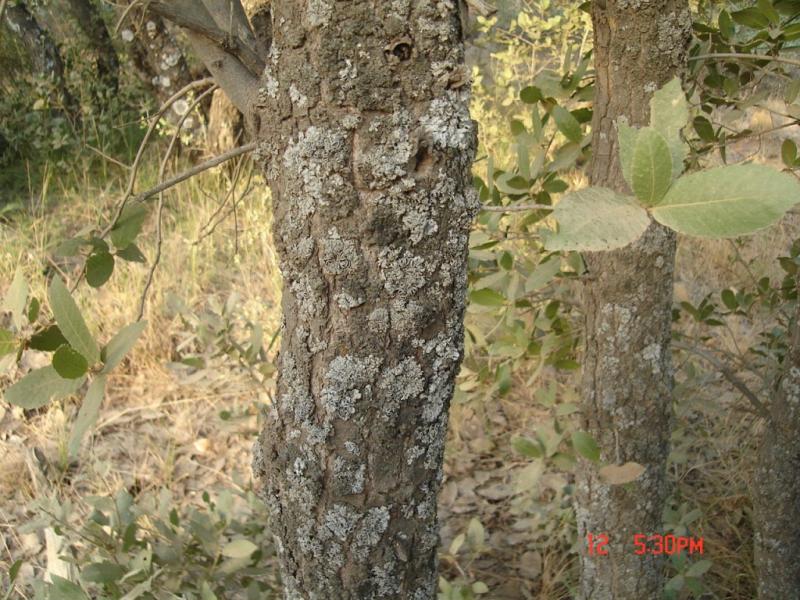
<sub>Figure 6. Trunk bark of </sub><em><sub>Quercus persica</sub></em><sub> © Parisa Panahi</sub>


IUCN Red List status
The species is currently assessed as Near Threatened and is due for a reassessment in 2025. Due to the decline in area of occupancy, number of mature individuals, and habitat quality, it is likely to be listed as Vulnerable.
Major threats
Due to the severe destruction and the prolonged climate change–induced drought over the past several decades in the Zagros forests (Sagheb Talebi et al. 2014; Attarod et al. 2023), especially in the southern parts, sexual regeneration of Q. persica is rarely seen in the forest floor. In other words, the survival of this species is related mainly to its sprouting capability. Individuals of Q. persica reproduce mainly by stump sprouts, so the main form of this species is coppice (Fig. 9).

Like other oak species of Zagros forests, the main threats of Q. persica are:
- overgrazing of livestock and subsequent destruction of all seedlings and saplings on the forest floor
- habitat disturbance and drought, cutting of tree branches (pollarding) for livestock feed and hedges
- cutting of trees for fuel, building materials, and charcoal
- acorn harvesting for traditional uses (especially animal feed, manna, and acorn flour for bread)
- rainfed agriculture beneath the trees.
In addition, the occurrence of the oak decline phenomenon in the southern parts of Zagros has caused the death of Q. persica individuals in the last two decades (Pourhashemi et al., 2017).
Works cited
Attarod, P., A. Dezhban, T.G. Pypker, Sh. Kh. Sigaroodi, V. Bayramzadeh, Q. Tang, X. Liu, and S.H. Mariv. 2023. Iran’s Changing Climate over the Past 30 Years. Russian Meteorology and Hydrology 48: 53–62. [link]
Bobek, H. 1951. Die natürlichen Wälder und Gehölzfluren Irans. Bonner Geographische Abhandlungen 8. Bonn: Selbstverlag des Geographischen Instituts der Universität Bonn. [link]
Djavanchir-Khoie, K. 1967. Les chênes de l`Iran. Ph.D. thesis. University of Montpellier, Montpellier, France.
Menitsky, G.L. 1971. Fagaceae. In: Rechinger, K.H., editor, Flora Iranica (Vol. 77: 1–20). Graz: Akademische Druck- u. Verlagsanstalt.
Mobayen, S. 1964. Plant Geography: Vegetation Communities Main Vegetation Lines of Iran, No. 209. Tehran: Tehran University Press, Tehran. (In Persian)
Panahi, P. 2011. Study of the diversity of Iranian oak species using pollen grain morphology and determining their conservation status. Ph.D thesis, University of Mazandaran, Sari, Iran. (In Persian)
Panahi, P., Z. Jamzad, M. Pourmajidian, A. Fallah, M. Pourhashemi, and H. Sohrabi. 2012. Taxonomic revision of the Quercus brantii complex (Fagaceae) in Iran with emphasis on leaf and pollen micromorphology. Acta Botanica Hungarica 54: 3–4. [link]
Parsa, A. 1949. Flore de l’Iran: Fagaceae (Vol. 4: 1319–1332). Tehran: Imprinerie Mazaheri.
Pourhashemi, M., H. Jahanbazi Goujani, J. Hoseinzadeh, S.K. Bordbar, Y. Iranmanesh, and Y, Khodakarami. 2017. The history of oak decline in Zagros forests. Iran Nature 2(1): 30–37. (In Persian) [link]
Sabeti, H. 1976. Forests, Trees and Shrubs of Iran. Tehran: Ministry of Agricultural and Natural Resources Press. (In Persian)
Sagheb Talebi, Kh., T. Sajedi, and M. Pourhashemi, M. 2014. Forests of Iran: A Treasure from the Past, A Hope for the Future. Springer. [link]
Content by the Same Author
The International Oak Society acknowledges the generous support of the following institutions:
Supporting Institutional Members



Standard Institutional Members