Editor's Picks
Website Editor
|
Oct 26, 2026

We were shocked to learn that Julianne Skai Arbor, also...
Website Editor
|
Oct 26, 2026
Over the past two decades, the Zagros forests have been...
Mehdi Pourhashemi
|
Oct 10, 2026
Plant Focus
The only oak species endemic to Africa is rare in cultivation. It shouldn't be.
In two previous articles (here and here), we have investigated the threats posed to the survival of California’s endemic oaks by climate change, and practical measures aimed at countering those threats, with an emphasis on in-situ conservation. In this article, in discussion with IOS member Amy Byrne of the Morton Arboretum and the Global Conservation Consortium for Oaks, we consider the value and potential of ex-situ conservation efforts.
Thanks to research by Amy’s colleague, Karina Orozco, we know how well represented in ex-situ collections are four of the endemic oaks, plus Notholithocarpus densiflorus. The data are as follows.
- Notholithocarpus densiflorus (tanoak) is in 32 collections, of which 53% are in North America, 44% in Europe and 3% in Australasia.
- Quercus douglasii (blue oak) is in 80 collections, of which 46% are in North America, 41% in Europe, 9% in Australasia, 3% in South America and 1% in the Middle East.
- Quercus engelmannii (Engelmann oak) is in 39 collections, of which 62% are in the USA, 21% in Europe, 16% in Australasia and 3% in South America.
- Quercus wislizeni (interior live oak) is in 70 collections, of which 44% are in North America, 44% in Europe, 6% in Australasia, 3% in South America and 1% in the Far East.
-
Quercus lobata (valley oak) is in 91 collections, of which 45% are in North America, 44% in Europe, 2% in South America and 9% in Australasia.
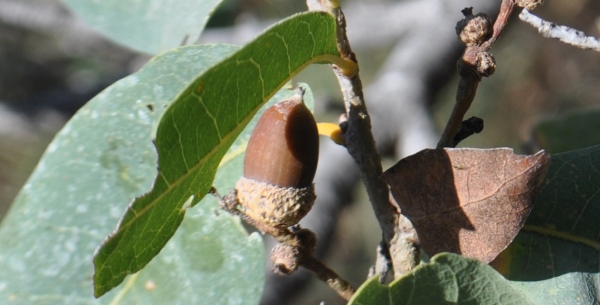
Quercus engelmannii, Santa Barbara Botanic Garden
© Charles Snyers
We might take from this that the true oaks, at least, are reasonably well-represented in collections with a range of climates. However, looking in more detail at Q. lobata, a problem emerges. McLaughlin et al. (2026) established its current IUCN Red List status as ‘Near Threatened’, but projected that it would escalate to ‘Endangered’ under conservative climate change estimates, and to ‘Critically Endangered’ under the most pessimistic scenario. That investigation treated Q. lobata as a single, relatively homogeneous taxon across its range. In an unrelated but complementary investigation, Sork et al. (2026) carried out a long-term common garden provenance trial, monitoring the growth and survival of progeny from 658 specimens of the same oak species. They found that it is maladapted to both the existing and the anticipated future climates over much of its range, but that there were significant differences between provenances, with populations from warmer climates surviving and growing better than those from cooler climates. It is likely that the growth of this oak will decline across much of its range, especially in low-elevation inland areas, while coastal regions and higher-elevation southern regions will show less extreme decline, and even increases, in tree size over time.
In conversation, Amy had stressed the critical role of ex-situ collections for research, education, and raising awareness, but also in safeguarding the wild genetic diversity of oak species and their value as repositories for potential reinforcement/restoration efforts of the species’ populations. But these findings strongly suggest that if ex-situ collections are to be managed as refugia for Q. lobata, the trees to be curated in them should originate from the most climate-adapted provenances from coastal and higher-elevation parts of the trees’ range. An obvious question follows: of the current 91 collections holding specimens of this tree, how many have detailed records of the collection locations, and of that number how many are known to have specimens of those climate-adapted provenances? We don’t know for sure, based on the current state of knowledge, but it’s likely to be few.
The research findings point to two priorities for the future. First, the US oak conservation gap analysis is to be updated in the next year or so and it should be informed by the results from McLaughlin et al. and Sork et al. Second, there is a need for more population genetic studies to assess the wild diversity capture of the species in living collections, which would inform conservationists and collection managers about the priority populations to target for collection to ensure their genetic diversity is backed up and safeguarded. Amy and her colleagues based at other arboreta have a crucial role to play, and we can only hope that the resources will be found to undertake both parts of this important research.
Works cited
, , , D.D.Ackerly, M.B.Rose, H.V. Moeller, and E.S. Zavaleta. 2026. Adapting Species Risk Assessments to a Changing Climate: The Underestimated Vulnerability of Foundational Trees. Global Change Biology 32(4): e70866 [link]
Sork, V.L., R.Buck, and A. Goetz. 2026. Preserving Oaks and Oak Ecosystems Vulnerable to Climate Change. International Oaks 36: 165–174 [link]
Content by the Same Author
The International Oak Society acknowledges the generous support of the following institutions:
Supporting Institutional Members




Standard Institutional Members