Editor's Picks
Website Editor
|
Oct 26, 2026

We were shocked to learn that Julianne Skai Arbor, also...
Website Editor
|
Oct 26, 2026
Over the past two decades, the Zagros forests have been...
Mehdi Pourhashemi
|
Oct 10, 2026
Plant Focus
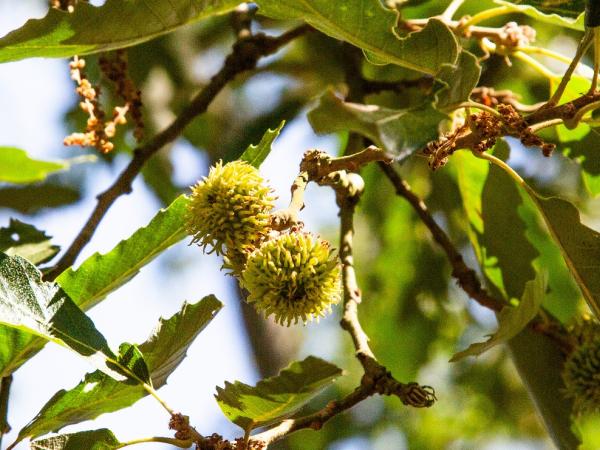
The only oak species endemic to Africa is rare in cultivation. It shouldn't be.
These are brief summaries of research papers that have come to our attention and which may be of interest to members
Genetic and morphological variation in taxonomically critical populations of Quercus petraea s.l. in Southern Europe.
Romeo Di Pietro, Elisa Proietti, Piera Di Marzio, Amara Noor Hussain, Katharina Birgit Budde, Kryštof Chytrý, Leonardo Filesi, Oliver Gailing, Lorenzo Gianguzzi, Duilio Iamonico, Nevena Kuzmanović, Dmitar Lakušić, Javier Loidi, Rizzieri Masin, Željko Škvorc, Giovanni Spampinato, Ivana Stevanoski, Benoît Vincent, Wolfgang Willner & Paola Fortini.
European Journal of Forest Research 145: 107, 2026
https://doi.org/10.1007/s10342-026-01938-x
Despite a good deal of research, taxonomists disagree about the number of taxa that should be included in the European white oak group at the species level. This is primarily due to the lack of consensus on the taxonomic assessment of a significant number of “critical” taxa, most of which belong to the collective groups of Quercus pubescens and Q. petraea.
This study investigated the genetic and morphological variability of critical populations of Q. petraea s.l. in southern Europe, considering taxonomic and biogeographical issues. Ten expressed sequence tag-simple sequence repeat (EST-SSR) markers were applied on 16 populations of Q. petraea s.l., including Q. petraea subsp. petraea, Q. petraea subsp. austrotyrrhenica, Q. dalechampii auct. non Ten, and Q. banatus, to assess genetic variation within and among populations using specific indices.
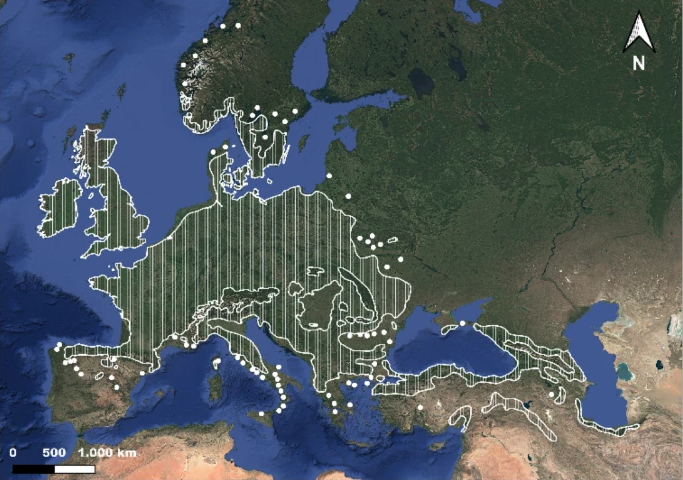
Dashed area: continuous range; dots: isolated populations.
The data gave some indication that the populations of Sicily and Calabria (Southern Italy) could be considered as an autonomous subspecies (Q. petraea subsp. austrotyrrhenica), but the authors considered the evidence too weak to confirm this. Other than that slight indication, the variability observed was insufficient to distinguish species other than Q. petraea (Matt.) Liebl. (i.e. Q. dalechampii auct. non Ten., Q. banatus Kučera). However, all Q. petraea s.l. populations were found to be clearly distinguishable from the Q. robur subsp. robur and Q. pubescens subsp. pubescens populations included in the dataset as outgroups.
Some relict populations of sessile oak in southern Italy, Sicily, and southern France were found to have undergone episodes of hybridization or introgression with Q. pubescens, a process that the authors claim could play a key role in preserving in-situ tree biodiversity in the context of current global warming. Conserving the largest possible collection of alleles for dominant oak species will be crucial for developing consistent conservation strategies for entire oak forest ecosystems in the near future.
Past projections of submediterranean oaks unveil future range shifts of vulnerable taxa under climate change
Carlos Vila-Viçosa, Salvador Arenas-Castro, Antoine Guisan, Elif Deniz Ülker, Jean Stephan, Isabel Passos, Francisco M. Vázquez, Rubim Almeida, João Honrado, Cristina García & João Gonçalves
Scientific Reports 16, 25611. 2026.
https://doi.org/10.1038/s41598-026-56522-5
This paper describes an investigation under the leadership of IOS member Carlos Vila-Viçosa and concerning the prospects for eight circummediterranean white oaks (Q. boissieri, Q. canariensis, Q. faginea, Q. infectoria, Q. kotschyana, Q. lusitanica, Q. pyrenaica, and Q. vulcanica) under a warming climate. These species comprise what the authors refer to as the submediterranean marcescent oak forests, and they form a climatic ecotone highly exposed to increasing aridity across the Mediterranean Basin.
On the assumption that an understanding of how these oak populations were affected by climate change in the past can inform thinking about their response to a future changing climate, the group used ensemble Species Distribution Models (SDMs) to infer past distribution changes from around 17,000 years ago to the present. The resulting information was used to estimate their likely distribution patterns under three SSP climate scenarios for 2070 and 2100.
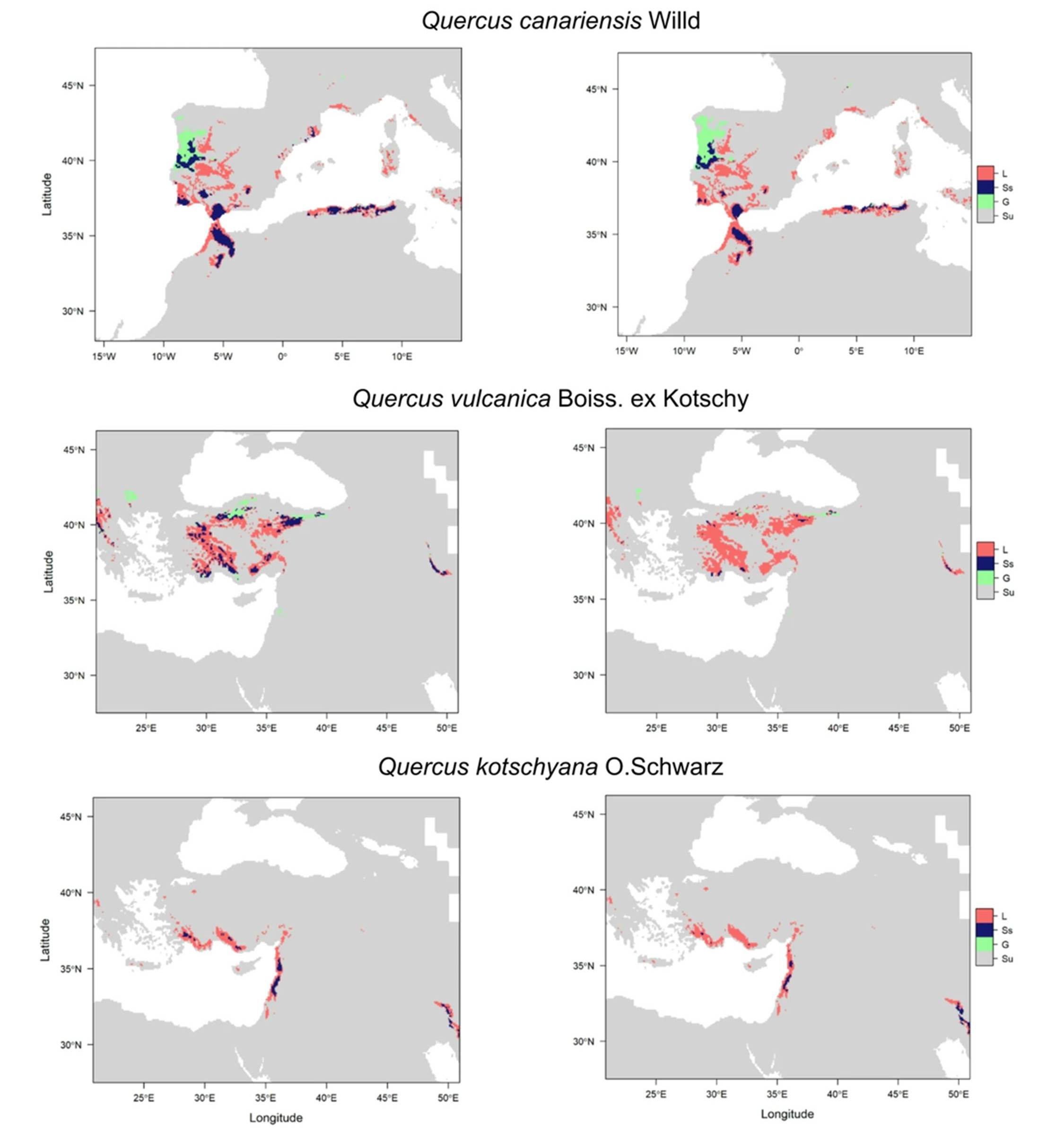
L-Loss; Ss-Stable suitable; G-Gain; Su-Stable unsuitable.
Using the IUCN assessment criteria, the Red List of Oaks 2020 assesses Q. kotschyana as Endangered, with no presence in ex-situ collections; Q. vulcanica as Least Concern and in 15 collections, and Q. canariensis as Data Deficient and in 83 collections. This present study confirms all three species as urgent conservation targets, warranting IUCN reassessment, although it should be noted that the committee that informs IPCC scenarios has officially eliminated SSP5-8.5 (used here as a worst-case scenario) as implausible because of reductions in coal burning through replacement by renewables. There are parallels here with the recent findings from California that the risks from a changing climate to several of its endemic oak species have been underestimated. The findings of this study refine the identification of potential climatic refugia and high-risk zones, offering a framework to prioritize conservation strategies for transitional oak forests in a rapidly warming Mediterranean Basin.
The genome assembly of Island Oak (Quercus tomentella), a relictual island tree species
Alayna Mead, Sorel T Fitz-Gibbon, Merly Escalona, Eric Beraut, Samuel Sacco, Mohan P A Marimuthu, Oanh Nguyen, and Victoria L Sork
Journal of Heredity 115(2): 221–229. 2024.
https://doi.org/10.1093/jhered/esae002
Island oak (Q. tomentella) is a rare oak that was once distributed across mainland California but is currently found only on six islands: five of the State’s Channel Islands (Santa Rosa, Santa Cruz, Anacapa, Catalina, and San Clemente) and Guadalupe Island in Baja California, Mexico. These island ecosystems have undergone major changes since settlement by the Spanish throughout the 1800s, including the introduction of non-native plants and herbivores, and as a result, island oak is categorized as Endangered by the IUCN Red List. In fact, this species may occupy only a small proportion of the potentially suitable habitat on the islands. Conservation and management of this species would benefit from understanding the genetic structure of populations within and across islands using genomic analyses.
As part of the California Conservation Genomics Project, a research group from University of California LA, Santa Cruz and Davis sequenced and assembled a genome for Q. tomentella. This will help to inform optimal management strategies by facilitating evaluations of genetic diversity across the range of the species. Previous work suggests that genetic diversity is significant, despite populations on some islands displaying clonal reproduction. Additionally, populations were genetically differentiated across islands, particularly the most isolated population on Guadalupe Island. It’s unclear whether this differentiation is due solely to isolation by distance, or also includes genetic variation involved in adaptation to the differing climate conditions on each island. This genome assembly will be valuable for future studies using whole-genome sequences to determine whether populations on each island differ in adaptive genetic variation. It will also be helpful in understanding the influence of a sister species, Q. chrysolepis, which is widespread across California and exhibits introgression with island oak throughout the California Channel Islands. The team will use this information to determine ideal seed sources for the replanting of Q. tomentella groves that are part of ongoing restoration projects on several islands.
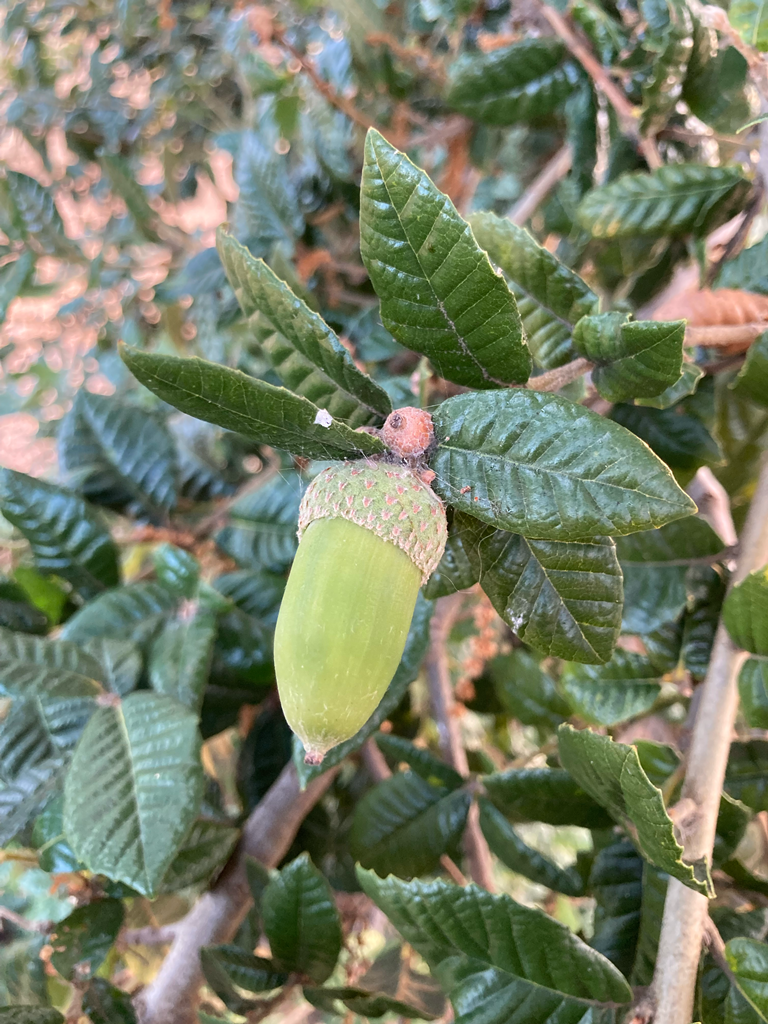
© Awinch 1001. Reproduction permitted
under the Creative Commons Attribution License 4.0.
Genomic data clarify identities and origins of purported hybrids and anomalous oaks on the Channel Islands of California
Ryan C. Buck, John Knapp, H. Scott Butterfield, Jeanette Howard, and Victoria L. Sork
Madroño 73(2): 89–112. 2026.
https://doi.org/10.3120/0024-9637-260014
On California’s Channel Islands, reports of hybrid oaks, such as Q. ×macdonaldii Greene & Kellogg, and anomalous individuals that appear to be oaks typically found on the mainland, including Q. lobata Née, Q. douglasii Hook. & Arn., and Q. engelmannii Greene, raise questions about their origin and history.
A research group from UCLA and The Nature Conservancy, California Program examined the validity of those reports by using nuclear and chloroplast whole-genome sequence data to elucidate species identities. As expected, they found that Q. ×macdonaldii individuals are hybrids between Q. lobata and the endemic Island Scrub Oak, Q. pacifica Nixon & C.H. Mull., but they identified only one pure Q. lobata individual on the islands, whose chlorotype is related to trees in the Santa Ynez Valley of Santa Barbara County, California. In addition, the trees thought to be Q. douglasii and Q. engelmannii are actually Q. pacifica × Q. douglasii and Q. pacifica × Q. engelmannii hybrids, respectively. These were determined to be F1 hybrids that exclusively have the chlorotype of Q. pacifica, indicating unidirectional hybridization with the Island Scrub Oak as the maternal parent. The lack of pure parental individuals raises the questions of where the pollen donors came from, when they were present on the islands, and why they have disappeared. The lack of backcrossed individuals or an F2 generation suggests the mainland species may not be adapted to Channel Island environments and probably does not represent an ancient population of these species on the islands. Instead, these findings are consistent with a more recent arrival, potentially supporting the notion that Indigenous Peoples brought the mainland species to the Channel Islands. Conservation managers are advised to be aware of the presence of hybrid individuals that are morphologically indistinguishable from their parental species and consult Indigenous groups on the preservation of mainland species and their hybrids.
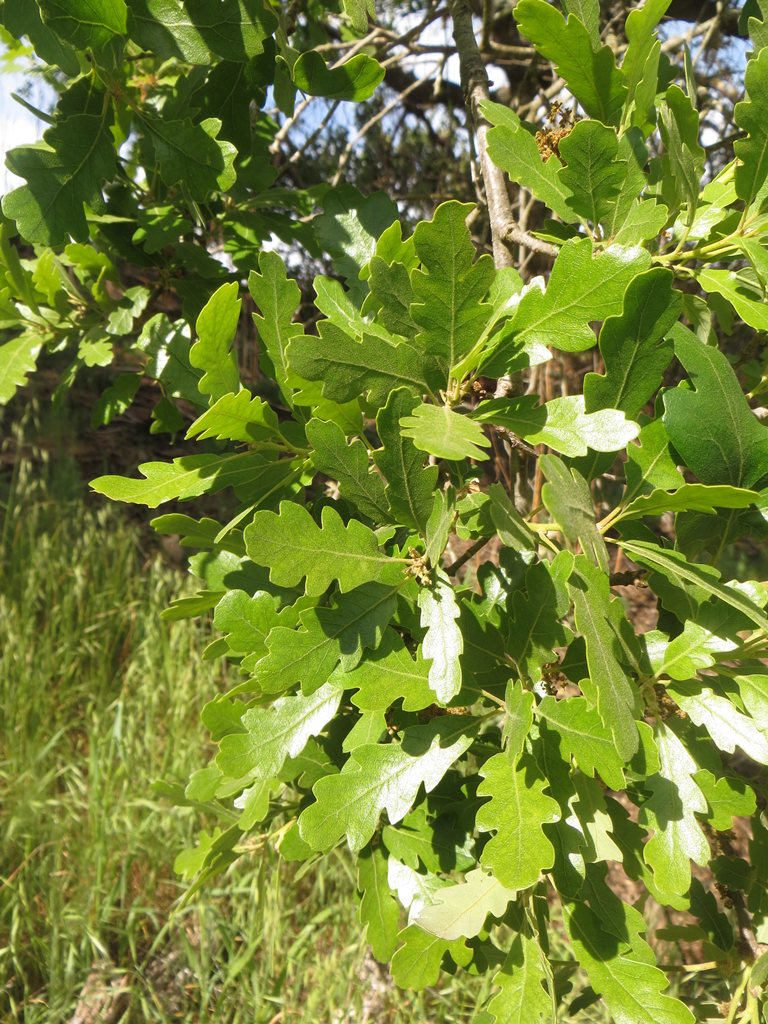
© Tentaculata. Reproduction permitted under the Creative Commons Attribution License 4.0
Content by the Same Author
The International Oak Society acknowledges the generous support of the following institutions:
Supporting Institutional Members




Standard Institutional Members