Editor's Picks

Website Editor
|
Oct 26, 2026

We were shocked to learn that Julianne Skai Arbor, also...
Website Editor
|
Oct 26, 2026
Over the past two decades, the Zagros forests have been...
Mehdi Pourhashemi
|
Oct 10, 2026
Plant Focus
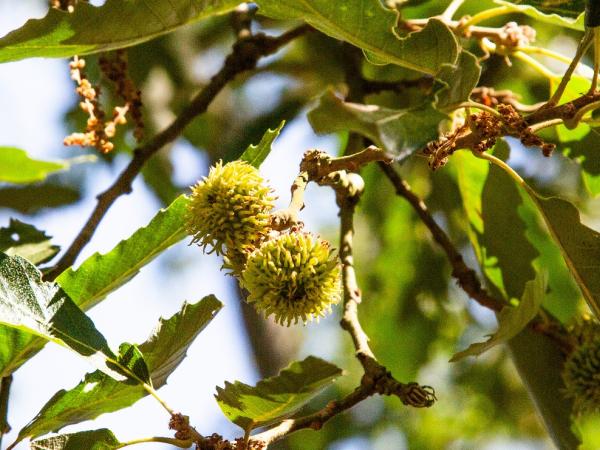
The only oak species endemic to Africa is rare in cultivation. It shouldn't be.
This new entry in our series on Oak Poetry features a stanza from a poem by Geoffrey Chaucer. "Troilus and Criseyde" is a tragic epic poem set during the Siege of Troy that chronicles the passionate love affair between a Trojan prince and a young widow, whose romance is ultimately ruined by the shifting politics of war and her eventual betrayal.
In Book II of Troilus and Criseyde, the stanza quoted below arrives at a critical turning point where the secret romance between the two protagonists shifts from passive pining to active, accelerating passion. Up to this moment, Troilus has been paralyzed by his unrequited love, but his fortunes change when Criseyde finally agrees to send him her very first letter. Chaucer introduces this stanza to illustrate the psychological shift occurring within Troilus upon reading her words. By using a series of compounding metaphors—fire being fed by fresh wood or coal, and a massive oak developing from a tiny sprout (spyr)—Chaucer illustrates how a small token of encouragement can consume someone. The letter acts as the ultimate catalyst: it validates Troilus's lingering hope, which instantly amplifies his desires and sets his heart ablaze, effectively launching the next phase of their tragic courtship.
[Modern English translation below]
But as we may alday ourselven see,
Through more wode or col, the more fyr;
Right so encrees hope, of what it be,
Therwith ful ofte encreseth eek desyr;
Or, as an ook cometh of a litel spyr,
So through this lettre, which that she him sente,
Encresen gan desyr, of which he brente.
[Modern English translation]
But as we may always see for ourselves,
Through more wood or coal, the greater the fire;
Just so, an increase of hope, from whatever cause it stems,
Along with it very often increases also desire;
Or, as an oak comes from a little sprout,
So through this letter, which she sent to him,
Began to increase desire, from which he burned.
Chaucer's word "spyr" is understood to mean "sapling". The line is thought to be the origin of the English proverb "Mighty oaks from little acorns grow" (see here for an account of the history of the phrase).
A few stanzas further on, Pandarus visits an anxious, suffering Troilus to cheer him up and explain his plan to orchestrate a meeting at Deiphebus’s house. Pandarus uses a classic argument to explain why a long, difficult pursuit of love is bound to succeed, explaining that a sturdy oak tree doesn't crash down from a single chop. Instead, it must be chopped at repeatedly for a long time until it finally receives the "happy falling strook," causing the entire massive weight of the tree to collapse all at once.
"Thenk here-ayeins, whan that the sturdy ook,
On which men hakketh ofte, for the nones,
Receyved hath the happy falling strook,
The grete sweigh doth it come al at ones,
As doon these rokkes or these milnestones.
1385 For swifter cours cometh thing that is of wighte,
Whan it descendeth, than don thinges lighte.
“Think, on the other hand, when the sturdy oak,
At which men hack often, for the purpose,
Has received the fortunate felling stroke,
The great swaying motion makes it come down all at once,
As do these rocks or these millstones.
For with a swifter course comes a thing that is of weight,
When it falls down, than do things that are light.
Pandarus follows this with a stark contrast: a flexible reed bends down under every blast of wind and lightly rises again once the storm ceases. An oak tree, however, refuses to bend—meaning that when the wind finally overcomes it, it is cast down completely and permanently.
"And reed that boweth doun for every blast,
Ful lightly, cesse wind, it wol aryse;
But so nil not an ook whan it is cast;
1390 It nedeth me nought thee longe to forbyse.
Men shal reioysen of a greet empryse
Acheved wel, and stant withouten doute,
Al han men been the lenger theraboute."
“And the reed that bows down for every blast of wind,
Very easily, once the wind ceases, it will rise up;
But so will an oak not do when it is thrown down;
There is no need for me to instruct you long with parables.
Men shall rejoice over a great enterprise
Well achieved, which stands firm without doubt,
Even though men have been all the longer busy about it.”

Image: The Poetry Foundation
Geoffrey Chaucer (c. 1343–1400) was an English poet, philosopher, and public servant recognized as the "father of English literature." Born into a prosperous London wine-merchant family, he spent most of his life in public affairs, serving under three successive kings: Edward III, Richard II, and Henry IV. His administrative career included roles as a court page, a soldier in the Hundred Years' War, a diplomat in Europe, a member of Parliament, and the Clerk of the King's Works. These official duties exposed him to Italian and French literary movements, which influenced his writing. By composing his works in Middle English rather than the dominant courtly French or scholarly Latin, he helped validate the vernacular language. He authored acclaimed works such as The Book of the Duchess and Troilus and Criseyde, and he is best known for The Canterbury Tales, a frame narrative valued for its social observations and humor. Following his death, he became the first poet buried in Westminster Abbey, establishing the area now known as Poets' Corner.
Content by the Same Author
The International Oak Society acknowledges the generous support of the following institutions:
Supporting Institutional Members




Standard Institutional Members