Editor's Picks

While working on a list of synonyms of European White Oaks...
Roderick Cameron
|
Aug 24, 2026
Report led by The Morton Arboretum will help prioritize oak...
Website Editor
|
Aug 06, 2026
Motivation
I live in the village of Dolné Dubové...
Jozef Čapkovič
|
Jul 20, 2026
Plant Focus
The only oak species endemic to Africa is rare in cultivation. It shouldn't be.
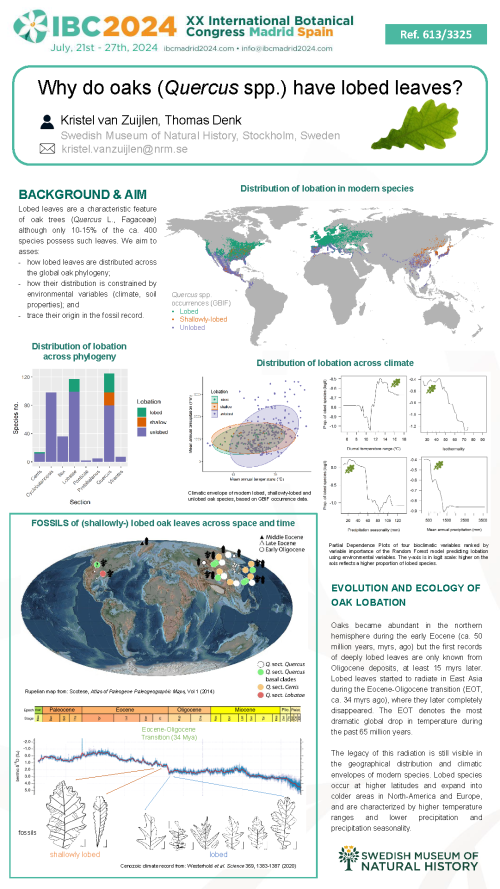
Poster presented at the XX International Botanical Conference, Madrid, Spain, July 21–27, 2024.
Authors:
Kristel van Zuijlen1, Thomas Denk1
Affiliation:
1. Swedish Museum of Natural History, Stockholm, Sweden
Abstract:
Lobed leaves are a characteristic feature of oak trees (Quercus L., Fagaceae) although only a subset of the more than 400 species do possess such leaves. Oaks became abundant in the northern hemisphere during the early Eocene (ca. 50 million years, myrs, ago) but the first records of deeply lobed leaves are only known from Oligocene deposits, at least 15 myrs later. Lobed leaves started to radiate during the Eocene-Oligocene transition (EOT, ca. 34 myrs ago), which denotes the most dramatic global drop in temperature during the past 65 million years. We aim to assess how lobed leaves and other leaf characteristics are distributed across the global oak phylogeny and how their distribution is constrained by climate. To do this, we compiled leaf traits and climate envelopes for all modern oak species. We then used the extensive leaf fossil record and past climate reconstructions to trace the origin of lobed oak leaves.
The International Oak Society acknowledges the generous support of the following institutions:
Supporting Institutional Members




Standard Institutional Members