Editor's Picks

While working on a list of synonyms of European White Oaks...
Roderick Cameron
|
Aug 24, 2026
Report led by The Morton Arboretum will help prioritize oak...
Website Editor
|
Aug 06, 2026
Motivation
I live in the village of Dolné Dubové...
Jozef Čapkovič
|
Jul 20, 2026
Plant Focus
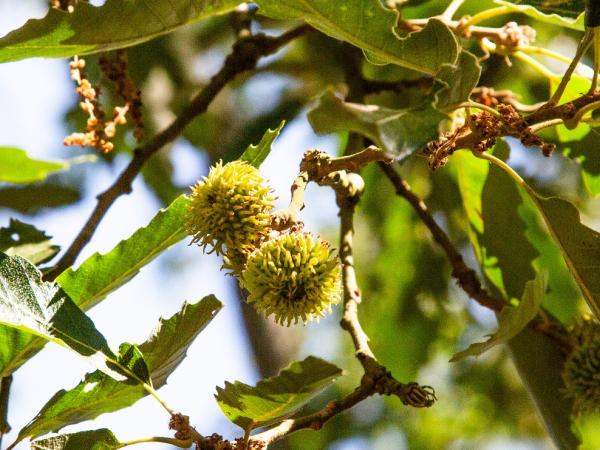
The only oak species endemic to Africa is rare in cultivation. It shouldn't be.
Propagation and reintroduction of an endangered oak: Quercus austrocochinchinensis, by Qian-sheng Li[1] & Min Deng[2], originally published in Oak News & Notes, Vol. 18, No. 1.
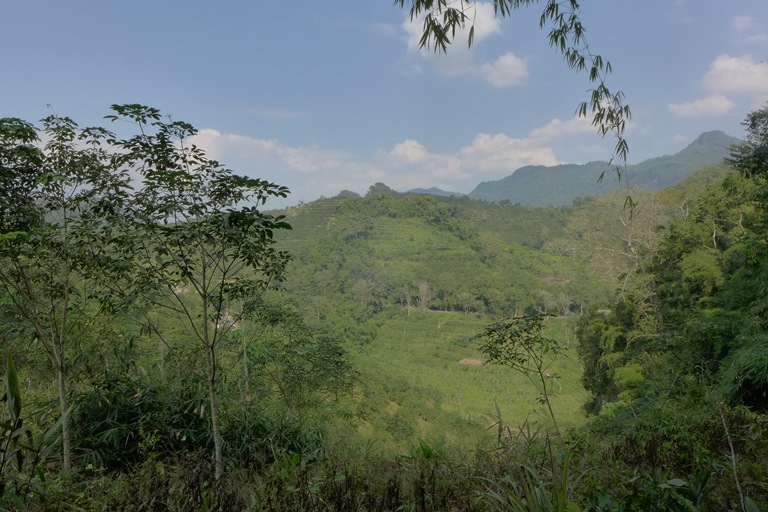
Quercus austrocochinchinensis Hickel & A. Camus is a critically endangered species. It has a scattered distribution in ravines of Hainan and southwest Yunnan provinces of China and northern Indochina and is one of the dominant tree species in these regions. Based on herbarium records, it was once the dominant tree of the seasonal tropical forest of these regions, but due to the development of the economy and agriculture, its habitats have been taken over by rubber tree and banana farms. As a result of this, the populations of Q. austrocochinchinensis have decreased dramatically and currently this species can only be found in nature reserves. It was included in the book China Species Red List[3].
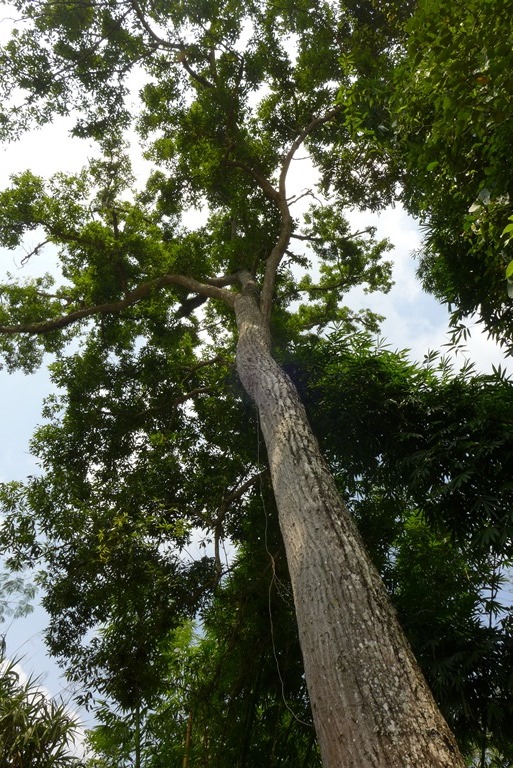
|
| A mature specimen of Quercus austrocochinchinensis |
|
| Habitat of Quercus austrocochinchinensis, taken over by agriculture. |
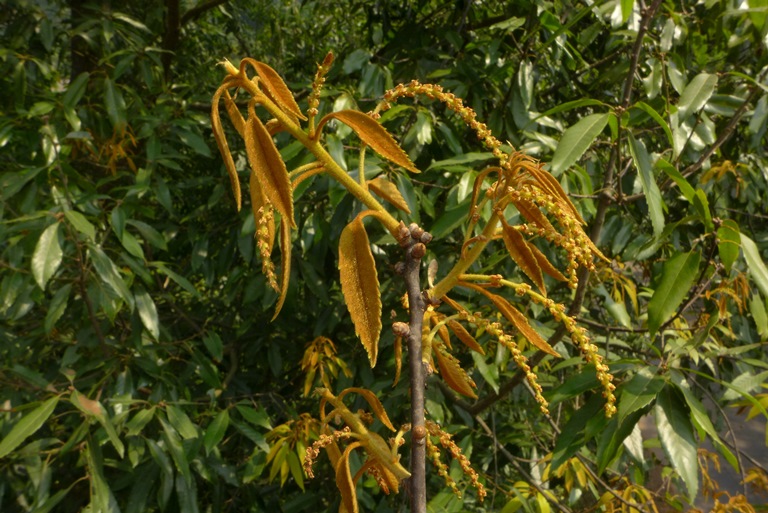
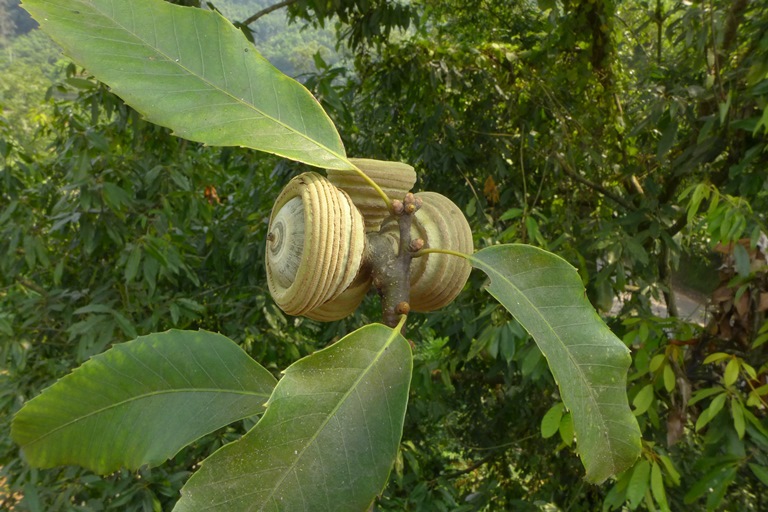
Q. austrocochinchinensis was placed in section Helferiana by Yury Menitsky[4], while Aimée Camus[5] grouped it under subdivision Breviglans, which is characterized by flat acorns. The trees can grow to 50 m/164 ft tall. The leaves are oblong-elliptic to lanceolate, 10-20 × 3-5 (9) cm/3.9-7.9 × 1.2-2 (3.5) in, and slightly leathery with a sharply toothed margin. They are yellow to brown and covered by dense fasciculate hairs when young, becoming glabrous when mature.
|
| Young leaves and male flowers. |
|
| Mature leaves and acorns. |
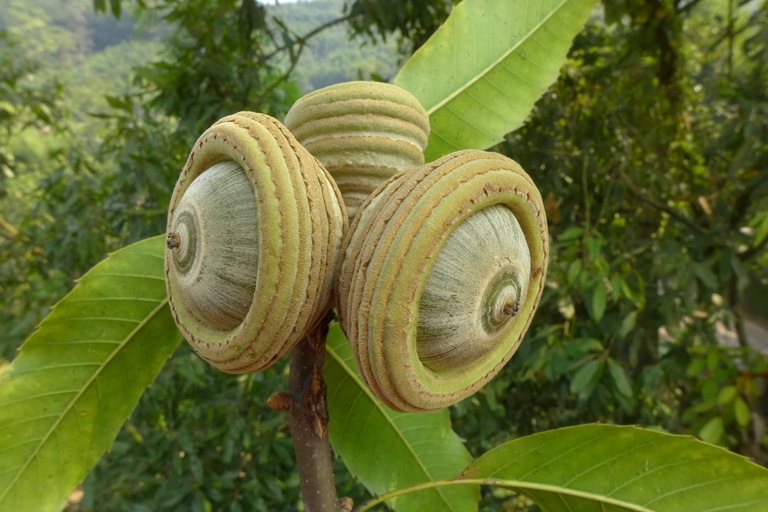
The cupule can be likened to a Chinese chess piece, covering most of the nut except for the top and is usually covered in dense, short gray hairs.
|
| Quercus austrocochinchinensis acorns. |
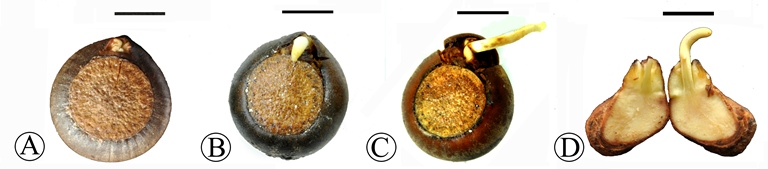
The acorn has a flat top with 4-5 styles. It is typically recalcitrant (cannot be stored for long periods) and will germinate as soon as it is ripe. In some extreme cases, it will even germinate while still on the branch. Acorns can germinate in 1 month when stored at 4 °C/39 °F in a refrigerator. Germination is unusual in that the radicle emerges from the seed scar instead of the style base.
|
| Germination of Quercus austrocochinchinensis acorns, with radicle emerging from the seed scar. |
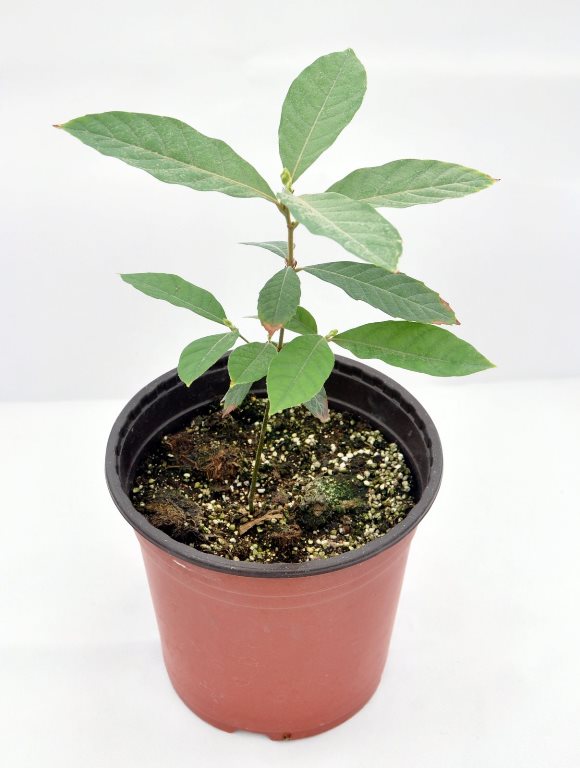
Despite the fact that acorns germinate readily, successful seedling establishment is very difficult. We have never found any young seedlings in the field. Conditions of high humidity are essential for germinated seeds to grow into seedlings. In drier air, the emerged young shoot will dry out. Sometimes, the seed will keep struggling to produce another young shoot and may do so several times, but without enough humidity, the shoot dies quickly. The young seedlings grow fast in a humid greenhouse and a one-year-old seedling can reach a height of 0.8 m/2.6 ft. They produce abundant lateral branches.
|
| Seedling. |
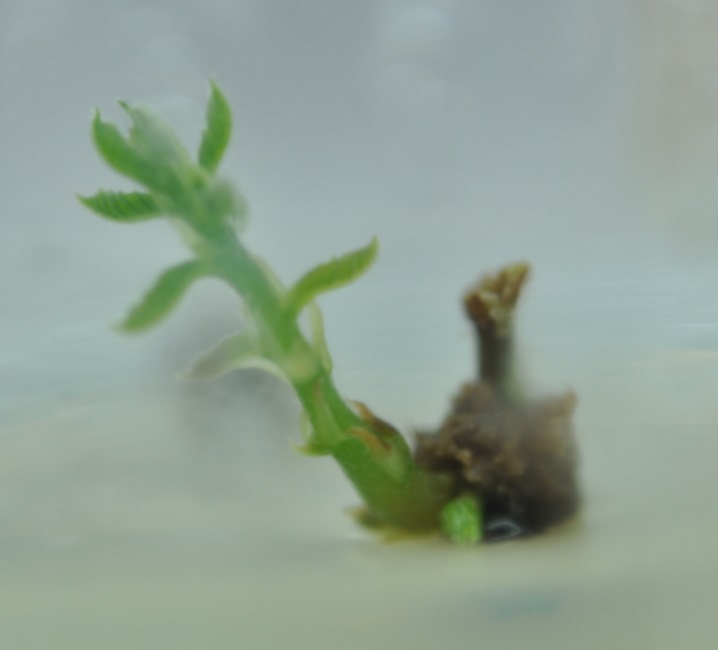
We were able to asexually propagate some seedlings via micropropagation and cuttings by using these young lateral shoots. Hopefully, by continuing this work in the future we can conserve, propagate and reintroduce this endangered oak.
|
| Micropropagation of Quercus austrocochinchinensis. |
ACKNOWLEDGEMENTS. This work was supported by grants from the National Natural Science Foundation of China (31270267), Shanghai Municipal Administration of Forestation and City Appearances (F112419).
[1] School of Ecology, Shanghai Institute of Technology, Shanghai 201418, China.
[2] Shanghai Chenshan Plant Science Research Center, Chinese Academy of Sciences, Shanghai 201602, China.
[3] Wang, S. & Xie, Y. 2004. China Species Red List. Volume 1. Higher Education Press, Beijing.
[4] Menitsky, Yu. L. (1984). Oaks of Asia. St. Petersburg, Leningosed Sciences.
[5] Camus, A. (1934-1954). Les Chênes. Monographie du genre Quercus and monographie du genre Lithocarpus. Paris, Lechevalier.
Content by the Same Author
The International Oak Society acknowledges the generous support of the following institutions:
Supporting Institutional Members




Standard Institutional Members