Editor's Picks
While working on a list of synonyms of European White Oaks...
Roderick Cameron
|
Aug 24, 2026
Report led by The Morton Arboretum will help prioritize oak...
Website Editor
|
Aug 06, 2026
Motivation
I live in the village of Dolné Dubové...
Jozef Čapkovič
|
Jul 20, 2026
Plant Focus
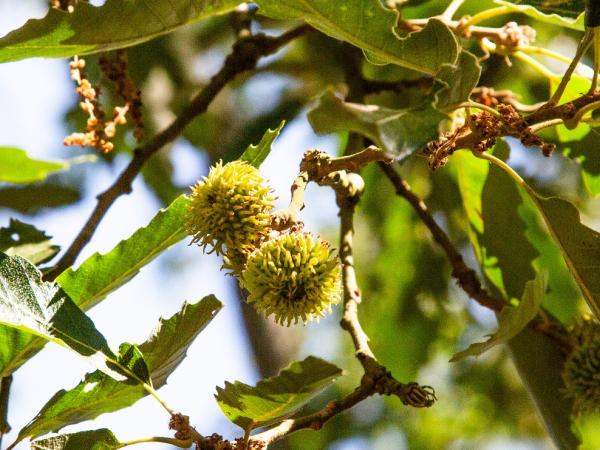
The only oak species endemic to Africa is rare in cultivation. It shouldn't be.
Poster presented at the XX International Botanical Conference, Madrid, Spain, July 21–27, 2024.
Authors:
Zaineb Mhalhli1, Issam Touhami1, Hammadi Achour2, Zouhair Nasar1, Touhami Rzigui1,2
Affiliations:
1. National Research Institute of Rural Engineering, Water and Forests (INRGREF), LR16INRGREF01 Laboratory of Management and Valorization of Forest Resources, Carthage University, Ariana 2080, Tunisia
2. Institute Sylvo-Pastoral of Tabarka, University of Jendouba, Tabarka 8189, Tunisia
Abstract:
Photosynthetic traits of four years Quercus Suber. L greenhouse seedlings coming from seven different Tunisian provenances were investigated:
JES: Djebal Essarej, SZD: Sidi Zid, KER: Kef Errand, DCH: Djebal Chahid, MEJ: Majel Essaf, FEJ: Feija, BEL: Bellif
JES, SZD, KER and DCH are the provenances originated from the driest sites meanwhile MEJ, FEJ and BEL are the ones originated from the wettest sites.
Using the Farquhar analysis model Farquhar et al., (1980), we reported a change in the maximum rate of carboxylation, Vcmax, from 63µmol m-2 s-1 for JES provenance to 82 µmol m-2 s-1 for MEJ provenance. Also, a shift in the maximum rate of electron transport, Jmax, was observed from 119 µmol m-2 s-1 for JES provenance to 155 µmol m-2 s-1 for MEJ provenance as well.
A strong correlation between Vcmax and Jmax was recorded. However Specific leaf area (SLA) and relative stomatal limitation (Ls) did not show any differences between the seven provenances. Additionally, MEJ and JES provenances had shown the highest and lowest CO2 assimilation rates at both natural ambient (An) and saturated CO2 (Asat), respectively.
These results indicate that provenances-specific differences in the CO2 uptake are due to the differences of the biochemical reactions capacities that regulate the gas-exchange process.
[Poster not available; research results in preparation for publication.]
The International Oak Society acknowledges the generous support of the following institutions:
Supporting Institutional Members




Standard Institutional Members