Editor's Picks

While working on a list of synonyms of European White Oaks...
Roderick Cameron
|
Aug 24, 2026
Report led by The Morton Arboretum will help prioritize oak...
Website Editor
|
Aug 06, 2026
Motivation
I live in the village of Dolné Dubové...
Jozef Čapkovič
|
Jul 20, 2026
Plant Focus
The only oak species endemic to Africa is rare in cultivation. It shouldn't be.
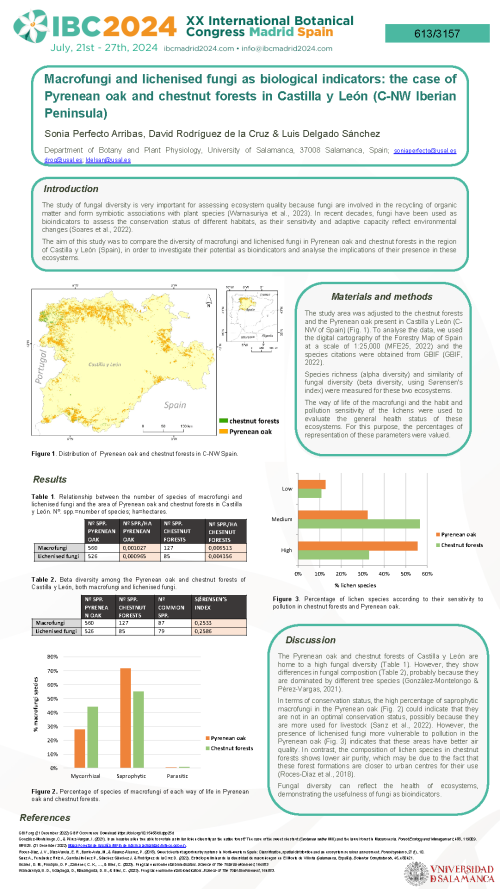
Macrofungi and lichenised fungi as biological indicators: the case of Pyrenean oak and chestnut forests in Castilla y León (Spain)
Poster presented at the XX International Botanical Conference, Madrid, Spain, July 21–27, 2024.
Authors:
Sonia Perfecto Arribas, David Rodríguez de la Cruz & Luis Delgado Sánchez
Affiliation:
Department of Botany and Plant Physiology, University of Salamanca, Salamanca, Spain
Abstract:
In recent decades, fungi have started to be used as bio-indicators to assess the biodiversity and conservation status of different habitats. Their usefulness as bio-indicators is due to their high adaptability and sensitivity, allowing them to reflect changes in ecosystem quality. In this study, in order to compare fungal diversity among the Pyrenean oak (Quercus pyrenaica Willd.) and chestnut (Castanea sativa Mill.) forests of Central Spain, we compiled records of macrofungi and lichenised fungi from the GBIF database using ArcGIS 10.8., and then analysed the possible implications of their presence for the conservation of these forest habitats.
560 species of macrofungi and 526 species of lichens were obtained in the Pyrenean oak forests and 127 species of macrofungi and 85 species of lichens in chestnut groves. In terms of macrofungal life mode, in Pyrenean oak forests there were 71.8% saprophytic species, 27.7% mycorrhizal and 0.5% parasitic, while in the chestnut groves there were 55.1% saprophytic, 44.1% mycorrhizal and 0.8% parasitic. Furthermore, analysing lichen sensitivity to contamination, 55.3% of the species showed high sensitivity in oak woods, while 56.5% showed medium sensitivity in chestnut forests.
Assessment of fungal diversity provides a holistic view of the health of forest ecosystems and could help identify areas requiring specific conservation measures. A better understanding of the relationship between fungal diversity and habitat quality would also contribute to the development of more effective management strategies for better habitat management. However, it would be advisable to carry out specific studies on a smaller scale to obtain more accurate results.
The International Oak Society acknowledges the generous support of the following institutions:
Supporting Institutional Members



Standard Institutional Members