Editor's Picks

While working on a list of synonyms of European White...
Roderick Cameron
|
Aug 24, 2026
Report led by The Morton Arboretum will help prioritize oak...
Website Editor
|
Aug 06, 2026
Motivation
I live in the village of Dolné Dubové...
Jozef Čapkovič
|
Jul 20, 2026
Plant Focus
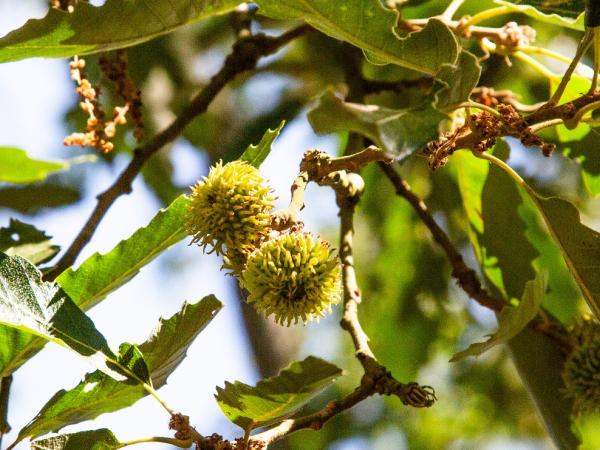
The only oak species endemic to Africa is rare in cultivation. It shouldn't be.
Names and Epithets
The scientific name of a species is the name of the genus to which it is assigned, followed by the specific epithet. Thus in Quercus palmeri, the word “Quercus” refers to the genus, and the word “palmeri” is the specific epithet.
An epithet is thus the word that defines a name.
The epithet in a name of a hybrid species is usually prefixed by a multiplication sign to indicate hybrid status. Thus Quercus ×warei is a hybrid species (also termed a nothospecies).
To give precision to a name, the author’s name is often appended at the end of a name, so that one knows the sense of a particular name. There have been times, especially in the past when communications were slower, when more than one author has unknowingly coined the same name to represent different species (only one of these names, usually the oldest, can be correct). Botanical authors’ names are often abbreviated according to botanical convention, so if you see Quercus palmeri Engelm., you would know that the author’s name is Georg Engelmann (1809–1884). Likewise the author of Quercus robur L. is Carl von Linnaeus (1707–1778) whose name is abbreviated by botanical tradition to “L.”. As in most other works of this sort, authors' name have here been abbreviated according to the standards laid out in R. K. Brummitt and C. E. Powell, "Authors of Plant Names" published by the Royal Botanic Gardens, Kew in 1992.
The epithet in the name of a cultivar may be more than one word: the entire epithet is enclosed within single (never double) quotation marks. Thus in Quercus ×bushii ‘Seattle Trident’ the words Seattle Trident form the cultivar epithet which is assigned to Quercus ×bushii.
The epithet of a Group name may also be of more than one word, but these are never enclosed in quotation marks.
The International Oak Society acknowledges the generous support of the following institutions:
Supporting Institutional Members




Standard Institutional Members