Editor's Picks
While working on a list of synonyms of European White Oaks...
Roderick Cameron
|
Aug 24, 2026
Report led by The Morton Arboretum will help prioritize oak...
Website Editor
|
Aug 06, 2026
Motivation
I live in the village of Dolné Dubové...
Jozef Čapkovič
|
Jul 20, 2026
Plant Focus
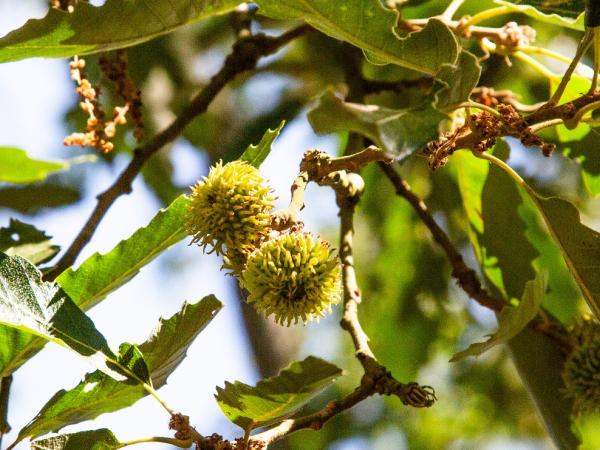
The only oak species endemic to Africa is rare in cultivation. It shouldn't be.
 Full text available for IOS members only. If you are a member, you need to log in.
 To create an account click here; if you have already registered, click here to become a member.
Individual articles can be purchased for U$S 10. If you would like to purchase an article, email a request to website@internationaloaksociety.org
Published May 2025 in International Oaks No. 36: 49–68
Abstract
Aimé Bonpland was one of the first botanists to describe Latin American Quercus. He collected oak specimens in Colombia in 1801 and in Mexico in the States of Guerrero, Hidalgo, Guanajuato, Michoacán, and Veracruz in 1803 and 1804. The oaks he described in Plantae Aequinoctiales were mostly recognized for over a century and half, and about half of them are considered today to be good species. In addition to their description, Bonpland included information about the type locality, etymology, evaluation of their economic and ornamental potential, and other details. In some cases, the taxonomy of his oak species has not been contested, in others there has been discussion about their status in the major treatments of Quercus in the past two centuries. An exploration of the etymology of the epithets he chose allows us to dig deeper into their meaning, while the history of their use in previous names gives an indication of Bonpland’s originality in his choices. Bonpland’s experience on the five-year voyage he undertook with Alexander von Humboldt marked him deeply, and half-way through his life he travelled to southern South America, never to leave that region. Though there were no native oaks there, he did have opportunity to remark on some oaks he saw there, making an intriguing recommendation.
Keywords
Quercus, Latin American oaks, neotropical botany, taxonomy, nomenclature, etymology
References
Angulo Peláez, G. 2018. “Aimé Bonpland: el botánico que murió dos veces.” Posted June 18, 2018, YouTube video, 45:39, https://www.youtube.com/watch?v=j_b4lfE-gFo
Arroyo Arango, M.A. 2019. “Almaguer.” Credencial Historia. https://www.revistacredencial.com/historia/temas/almaguer
Bartholomew, B., and F. Almeda. 2023. Nomenclator botanicus of Fagaceae in Latin America. Phytotaxa 580 (1): 001-097.
Bell, S. 2010. A Life in Shadow. Aimé Bonpland in Southern South America, 1817-1858. Stanford, California: Stanford University Press.
Cameron, R. 2019. “Humboldt Oaks in the Mist.” International Oak Society. https://www.internationaloaksociety.org/content/humboldt-oaks-mist
Cameron, R. 2024. “Quercus coccolobifolia: How a Name Was Lost. International Oak Society.” https://www.internationaloaksociety.org/content/quercus-coccolobifolia-h...
Coombes, A., and S. Valencia-A. 2020. Nomenclatural revision and lectotypification of five species of Mexican oaks: Quercus (Fagaceae). Phytotaxa 428(2): 081-092. https://doi.org/10.11646/phytotaxa.428.2.2
Cuatrecasas, J. 1944. Notas a la Flora de Colombia, VI. Revista de la Academia Colombiana de Ciencias Exactaas, Físicas y Naturales VI (21): 32-67.
De Candolle, A. 1864. Cupuliferae in Prodromus Systematis Naturalis Regni Vegetabilis 16(2): 1-123. Paris: Sumtibus Victoris Masson et Filii.
Flannery, M. 2019. “Humboldt: Essay on the Geography of Plants.” Herbarium World: Exploring herbaria and their importance. https://herbariumworld.wordpress.com/2019/09/23/humboldt-essay-on-the-ge...
Giberti, G.C. 1990. Bonpland’s Manuscript Name for the Yerba Mate and Ilex theezans C. Martis ex Reisseck (Aquifoliaceae). Taxon 39(4): 663-665.
Helfreich, G. 2004. Humboldt’s Cosmos: Alexander Von Humboldt and the Latin American Journey That Changed the Way We See the World. New York: Gotham Books.
Hiepko, P. 1987. The collections of the Botanical Museum Berlin-Dahlem (B) and their history. Englera 7: 219-252.
Hipp, A.L. 2024. Oak Origins: From Acorns to Species and the Tree of Life. Chicago and London: The University of Chicago Press.
Humboldt, A. von, and A. Bonpland. 1805. Essai sur la géographie des plantes : accompagnéd’un tableau physique des régions équinoxiales, fondésur des mesures exécutées, depuis le dixième degré de latitude boréale jusqu’au dixième degré de latitude australe, pendant les années 1799, 1800, 1801, 1802 et 1803. Paris : Chez Levrault, Schoell et compagnie.
IPNI. 2025. International Plant Names Index. The Royal Botanic Gardens, Kew, Harvard University Herbaria & Libraries and Australian National Herbarium. http://www.ipni.org Accessed 12 January 2025.
Krapovickas, A. 2008. Bonpland, sesquicentenario de su muerte. Bonplandia 17(1): 5-11.
Kunth, C.S. 1817. Nova genera et species plantarum. Vol. 2. Paris: Librairie Grecque-Latine-Allemande.
Medina Franco, G. 2021. “Quindío, el histórico paraíso de los colibríes.” Hotel Mocawa Resort. https://hotelmocawaresort.com/quindio-el-historico-paraiso-de-los-colibr...
Muller, C.H. 1942. The Central American Species of Quercus. Washington: United States Dept. of Agriculture.
Muller, C.H., and R. McVaugh. 1972. The Oaks (Quercus) Described by Nee (1801), and by Humboldt & Bonpland (1809), with Comments on Related Species. Contributions from the University of Michigan Herbarium 9(7): 507-522.
Mykhalevych, N. 2024. “Las raíces colombianas: El significado detrás del nombre de los 32 departamentos de Colombia.” Preply Inc. https://preply.com/es/blog/etimologia-nombre-departamentos-colombia/
POWO. 2025. Plants of the World Online. Facilitated by the Royal Botanic Gardens, Kew. https://powo.science.kew.org/ Accessed 12 January 2025.
Pulido, M.T., J. Cavelier, and S.P. Cortés. 2006. Structure and Composition of Colombian Montane Oak Forests. In Ecological Studies, Vol. 185: Ecology and Conservation of Neotropical Montane Oak Forests, ed. by M. Kappelle, pp. 141-151. Berlin, Heidelberg: Springer-Verlag
Rodríguez Correa, H., J.D. Palacio, D.Y. Barrios, K. Oyama Nakagawa, A. González Rodríguez. Quercus humboldtii Bonpl. en los Andes colombianos, Estructura y Diversidad Genética. Poster presented at: Simposio Taller Latinoamericano de Evolución Molecular 2011.
Rojo, R. 2012. “Setecientos años de historia.” Amigos de Corral de Almaguer. https://www.amigosdecorral.net/historia/historia-de-corral/140-setecient...
Schwarz, O. 1937. Fagaceae. In Burret, M. Plantae Duqueanae. Notizblatt des Königl. botanischen Gartens und Museums zu Berlin 13(119): 489-500.
Sprague, T.A. 1926. Humboldt and Bonpland’s Itinerary in Colombia. Bulletin of Miscellaneous Information Vol. 1926(1): 23-30.
Stauffer, F.W., and J. Stauffer. 2020. The Goujaud Bonpland Brothers: Two Complementary Approaches of Botanical Knowledge. Bonplandia 29(2): 253-270.
Trelease, W.L. 1922. Quercus. In Standley, P.C. Trees and Shrubs of Mexico (Fagaceae-Fabaceae). Contributions from the United States National Herbarium 23(2): 171-198.
Trelease, W.L. 1924. The American Oaks. Memoirs of the National Academy of Sciences. 20: 1-255.
Turland, N. J., Wiersema, J. H., Barrie, F. R., Greuter, W., Hawksworth, D. L., Herendeen, P. S., Knapp, S., Kusber, W.-H., Li, D.-Z., Marhold, K., May, T. W., McNeill, J., Monro, A. M., Prado, J., Price, M. J. & Smith, G. F. (eds.) 2018: International Code of Nomenclature for algae, fungi, and plants (Shenzhen Code) adopted by the Nineteenth International Botanical Congress Shenzhen, China, July 2017. Regnum Vegetabile 159. Glashütten: Koeltz Botanical Books. https://doi.org/10.12705/Code.2018
Valencia-A., S. 2004. Diversidad del género Quercus (Fagaceae) en México. Boletín de la Sociedad Botánica de México 75: 33-53.
Ventura, D. 2022. Aimé Bonpland, el brillante botánico opacado por Alexander von Humboldt que se enamoró de Latinoamérica. BBC News Mundo. https://www.bbc.com/mundo/noticias-59593096
Zorrilla-Azcué, S., A. González-Rodríguez, K. Oyama, M.A. González, H. Rodríguez-Correa. 2021. The DNA history of the lonely oak: Quercus humboldtii phylogeography in the Colombian Andes. Ecology and Evolution 11: 6814-6828.
The International Oak Society acknowledges the generous support of the following institutions:
Supporting Institutional Members



Standard Institutional Members