Editor's Picks

While working on a list of synonyms of European White Oaks...
Roderick Cameron
|
Aug 24, 2026
Report led by The Morton Arboretum will help prioritize oak...
Website Editor
|
Aug 06, 2026
Motivation
I live in the village of Dolné Dubové...
Jozef Čapkovič
|
Jul 20, 2026
Plant Focus
The only oak species endemic to Africa is rare in cultivation. It shouldn't be.
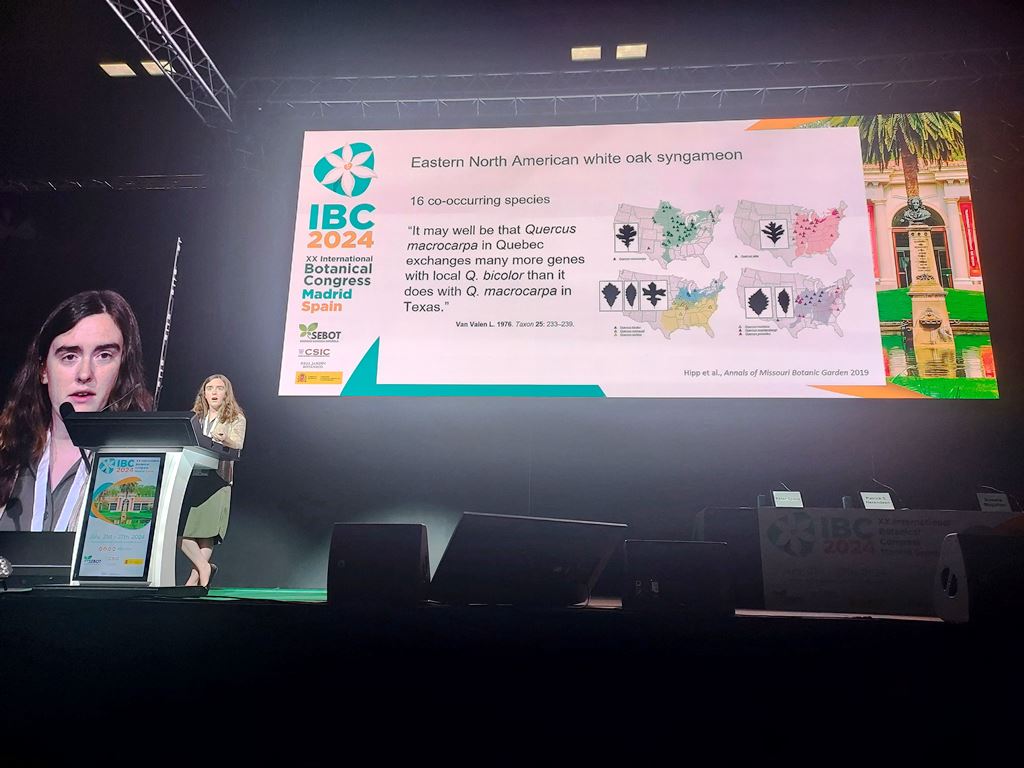
Presentation given at the XX International Botanical Conference, Madrid, Spain, July 21–27, 2024.
Authors:
Rebekah Mohn1, Mira Garner2, Leah Samuels1, Paul S. Manos3, Alan S. Whittemore1, Ian S. Pearse4, Jeannine Cavender-Bares5,6, Peter G. Kennedy7, Heather R. McCarthy8, Andrew L. Hipp1
Affiliations:
1. Science and Conservation, The Morton Arboretum, Lisle, Illinois, USA
2. Pritzker Laboratory for Molecular Systematics and Evolution, The Field Museum, Chicago, Illinois,USA
3. Department of Biology, Duke University, Durham, North Carolina, USA
4. U.S. Geological Survey, Fort Collins Science Center, Fort Collins, Colorado,USA
5. Department of Ecology, Evolution, and Behavior, University of Minnesota, St. Paul, Minnesota, USA
6. Department of Organismic and Evolutionary Biology, Harvard University, Cambridge, Massachusetts, USA
7. Department of Plant and Microbial Biology, University of Minnesota, St. Paul, Minnesota, USA
8. Department of Microbiology and Plant Biology, The University of Oklahoma, Norman, Oklahoma,USA
Abstract:
Quercus macrocarpa Michx. (Fagaceae) is a common, morphologically variable, and geographically and ecologically widespread species in eastern North America. This species is one of more than 16 eastern North American members of the white oak section, Quercus sect. Quercus. All are capable of interbreeding in sympatry and have been the subject of numerous previous studies, but limited genomic work. It has been proposed that multispecies introgression in the oak syngameon has contributed to the adaptation of eastern North American white oaks including Q. macrocarpa to a variety of ecological conditions. To evaluate the pattern of genetic diversity in the species and test for landscape-scale patterns of gene flow, we did genome resequencing across this species and 10 co-occurring species. Our resequencing data includes 693 individuals across the range of Q. macrocarpa, sequenced to an average depth of 21x. Thus far, we have identified approximately 50 highly introgressed individuals with slightly more than a third F1 hybrids, but the remainder showing evidence of introgression back into parental species at around the F2 or F3 generation. Most of the hybridization is concentrated near the boundaries of the parental species. As previously documented, the chloroplast does not appear to correspond with species identity. Interestingly, it also does not seem to strictly correspond to geographical proximity either. Quercus macrocarpa exhibits population structure between the northwest, northeast, and southwest regions of its distribution despite its long-range pollen movement. This work is part of a bigger collaboration to characterize the reciprocal influences of environment, migration history, and forest community structure on introgression across the range of Quercus macrocarpa, and the potential effects on the organisms who depend on and live with oaks.
The International Oak Society acknowledges the generous support of the following institutions:
Supporting Institutional Members




Standard Institutional Members