Editor's Picks

While working on a list of synonyms of European White Oaks...
Roderick Cameron
|
Aug 24, 2026
Report led by The Morton Arboretum will help prioritize oak...
Website Editor
|
Aug 06, 2026
Motivation
I live in the village of Dolné Dubové...
Jozef Čapkovič
|
Jul 20, 2026
Plant Focus
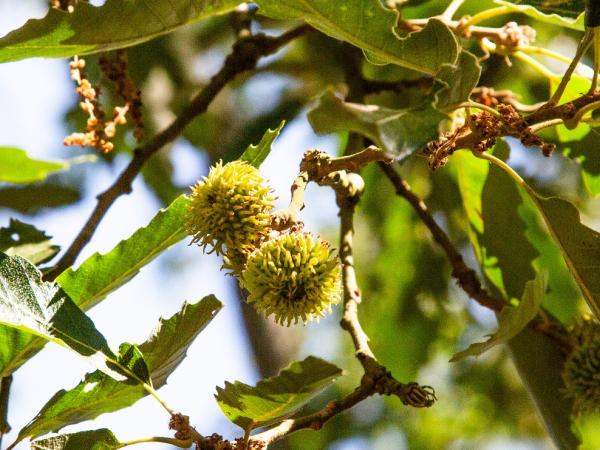
The only oak species endemic to Africa is rare in cultivation. It shouldn't be.
Jurupa Hills oak may be California's oldest plant
Researchers from UC Davis and UC Riverside say the 75-foot-wide Palmer's oak shrub has lived about 13,000 years despite inhospitable surroundings, regenerating itself with new shoots.

Michael May, an undergraduate student at UC Davis, next to a clone of a Palmer's Oak in Riverside County
Nestled between two boulders on a low rise in the Jurupa Hills of Riverside County, a good 30 miles from its nearest living relative, lies the ultimate survivor—an oak bush that researchers believe is 13,000 years old.
That's 1,000 years older than a previously identified Palm Springs creosote bush that was thought to be the oldest plant in California, 8,000 years older than bristlecone pines and 10,000 years older than the redwoods.
While it is one of the world's oldest living plants, it is probably not the oldest. That distinction may belong to a quaking aspen in Utah that is thought to be as old as 80,000 years or a holly in Tasmania that may be 43,000 years old.
But the Jurupa oak, researchers reported Tuesday in the online journal PLoS One, is unusual in that it is well out of its normal environment, which would be high in the mountains. It took seed at its current location near the end of the last Ice Age, when the climate was cooler and wetter. As its brethren died out because of climatic change, it persisted.
"If you planted a seedling there now, I doubt very much whether it would grow," said plant scientist Jeffrey Ross-Ibarra of UC Davis, lead author of the paper by UC Davis and UC Riverside scientists.
Because there are no other members of its species—Quercus palmeri or Palmer's oak—around to pollinate it, the shrub is infertile and grows clonally. When the trunk is destroyed by burning, new shoots pop up all around it from the roots. Over the millenniums, the Jurupa oak has spread until it is now more than 75 feet across. Genetic testing of individual stems shows that all are part of the same organism, Ross-Ibarra said.
The researchers estimated the plant's age by measuring growth rings and the rate of its spread. Termites have destroyed dead wood, precluding the use of radiocarbon-dating to get a more precise age.
Although the plant has survived since the Ice Age, its future is unclear. On one side of its hill are suburban backyards; on the other, off-roaders ride bikes and other vehicles. How long the oak can withstand encroachment is anyone's guess, Ross-Ibarra said. The scientists are talking to local officials about possible measures to protect it.
thomas.maugh@latimes.com
Copyright © 2010, The Los Angeles Times
Content by the Same Author
The International Oak Society acknowledges the generous support of the following institutions:
Supporting Institutional Members



Standard Institutional Members