Editor's Picks

While working on a list of synonyms of European White...
Roderick Cameron
|
Aug 24, 2026
Report led by The Morton Arboretum will help prioritize oak...
Website Editor
|
Aug 06, 2026
Motivation
I live in the village of Dolné Dubové...
Jozef Čapkovič
|
Jul 20, 2026
Plant Focus
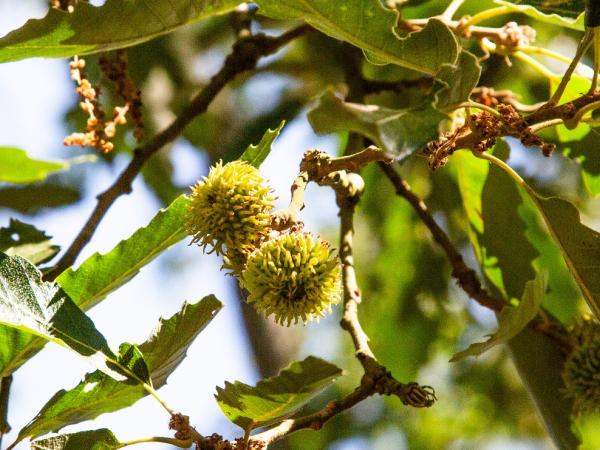
The only oak species endemic to Africa is rare in cultivation. It shouldn't be.
 Full text available for IOS members only. If you are a member, you need to log in.
 To create an account click here; if you have already registered, click here to become a member.
Individual articles can be purchased for U$S 10. If you would like to purchase an article, email a request to website@internationaloaksociety.org
Christopher C. Riely, William J. Walker, Deanna Phan, Robert T. Fahey, Amanda Bunce, and Scott R. McWilliams
Published May 2025 in International Oaks No. 36: 95–106
Abstract
We established a planting trial to compare the performance of several native and assisted migration candidate non-native oak species over a 5-year period in a natural upland forest setting in Rhode Island, USA. This study is among the first of its kind focusing on oaks and assisted migration in the region where North America’s oak-dominated forests extend farthest to the northeast. Results from the first growing season contradicted our hypothesis that native seedlings would perform better than non-native species in current conditions, with the non-native species exhibiting higher survival rates and greater height growth overall. Species rather than initial height or diameter was the most important factor in determining the performance of the oak seedlings, which suggests that careful selection of oak species is important to the early success of a planting project. The survival and growth of the most successful species is likely partly explained by their range of habitat tolerances matching well with site characteristics and seasonally dry weather conditions. Although the seedlings have not yet lived through their first winter, early results show most of these nursery-sourced oaks surviving in unproductive soils, with the non-native species not only keeping pace with the natives but growing somewhat better. Practical lessons gained from this oak adaptation planting will inform best practices that can benefit future efforts in the region and elsewhere.
Keywords
adaptation, climate change, tree planting, Quercus, tree seedling, silviculture
References
Bower, A.D., K.L. Frerker, C.C. Pike, N.R. Labonte, B.J. Pailik, A.A. Royo, S.M. Anderson, A.R. Ferreira, and L.A. Brandt. 2024. A practical framework for applied forestry assisted migration. Frontiers in Forests and Global Change 7 https://doi.org/10.3389/ffgc.2024.1454329.
Butler, B.J. 2015. The Forests of Southern New England, 2012: A Report on the Forest Resources of Connecticut, Massachusetts. Resource Bulletin NRS-97, USDA Forest Service, Northern Research Station, Newtown Square, PA.
Clark, P.W., A.W. D’Amato, K.S. Evans, P.G. Schaberg, and C.W. Woodall. 2022. Ecological memory and regional context influence performance of adaptation plantings in northeastern US temperate forests. Journal of Applied Ecology 59(1): 314-329. https://doi.org/10.1111/1365-2664.14056.
Clark, P.W., A.W. D’Amato, B.J. Palik, C.W. Woodall, P.A. Dubuque, G.J. Edge, J.P. Hartman, et al. 2023. A lack of ecological diversity in forest nurseries limits the achievement of tree-planting objectives in responseto global change. BioScience 73(8): 575-586. https://doi.org/10.1093/biosci/biad049.
Clark, P.W., A.W. D’Amato, L.A. Fitts, M.K. Janowiak, R.A. Montgomery, and B.J. Palik. 2024. Forest assisted migration and adaptation plantings in the Northeastern US: perspectives and applications from early adopters. Frontiers in Forests and Global Change 7. https://doi.org/10.3389/ffgc.2024.1386211.
Dupigny-Giroux, L.A., E.L. Mercray, M.D. Lemcke-Stampone, G.A. Hodgkins, E.E. Lentz, K.E. Mills, E.D. Lane, et al. 2018. Northeast. In: Climate Science Special Report: Fourth National Climate Assessment, Volume II. U.S. Global Change Research Program, Washington. https://nca2018.globalchange.gov/chapter/18/.
Fralish, J.S. 2003. The Central Hardwood Forest: Its Boundaries and Physiographic Provinces. General Technical Report NC-234, St. Paul, MN: USDA Forest Service, North Central Research Station.
Janowiak, M.K., A.W. D’Amato, C.W. Swanston, L. Iverson, F.R. Thompson, W.D. Dijak, S. Matthews, M.P. Peters, and A. Prasad. 2018. New England and northern New York forest ecosystem vulnerability assessment and synthesis: A report from the New England Climate Change Response Framework project. General Technical Report NRS-173, U.S. Department of Agriculture, Forest Service, Northern Research Station, Newtown Square, PA. https://doi.org/10.2737/nrs-gtr-173.
Millar, C.I., N.L. Stephenson, and S.L. Stephens. 2007. Climate Change and Forests of the Future: Managing in the Face of Uncertainty. Ecological Applications 17(8): 2145-2151. https://doi.org/10.1890/06-1715.1.
Miller, K.M., and B.J. McGill. 2019. Compounding human stressors cause major regeneration debt in over half of eastern US forests. Journal of Applied Ecology 56(6): 1355-1366. https://doi.org/10.1111/1365-2664.13375.
Nagel, L.M., B.J. Palik, M.A. Battaglia, A.W. D’Amato, J.M. Guldin, C.W. Swanston, M.K. Janowiak, et al. 2017. Adaptive Silviculture for Climate Change: A National Experiment in Manager-Scientist Partnerships to Apply an Adaptation Framework. Journal of Forestry 115(3): 167-178.
Palik, B.J., P.W. Clark, A.W. D’Amato, C. Swanston, and L. Nagel. 2022. Operationalizing forest-assisted migration in the context of climate change adaptation: Examples from the eastern USA. Ecosphere 13:e4260. https://doi.org/10.1002/ecs2.4260.
Park, A., and C. Talbot. 2018. Information Underload: Ecological Complexity, Incomplete Knowledge, and Data Deficits Create Challenges for the Assisted Migration of Forest Trees. BioScience 68 (4): 251–263. https://doi.org/10.1093/biosci/biy001.
Pedlar, J.H., D.W. McKenney, K. Sandvall, H. Zurbrigg, and K. McLaven. 2024. Assisted migration outcomes for oak species and seed sources in southern Ontario, Canada. Frontiers in Forests and Global Change 7. https://doi.org/10.3389/ffgc.2024.1445029.
Perry, J. 2024. “Red Flag warnings in RI continue as drought brings brush fire danger. What to know.” The Providence Journal, November 12, 2024.
Peters, M.P., A.M. Prasad, S.N. Matthews, and L.R. Iverson. 2020. Climate Change Tree Atlas, Version 4. USDA Forest Service, Northern Research Station and Northern Institute of Applied Climate Science. Accessed August 6, 2024. https://www.fs.usda. gov/nrs/atlas/tree.
Posit Software. 2024. R Studio Desktop. Accessed October 17, 2024. https://posit.co/download/rstudio-desktop.
R Foundation. 2024. The R Project for Statistical Computing. Accessed October 17, 2024. https://www.r-project.org/.
Riely, C., M. Janowiak, A. Mahafffey, and T. Worthley. 2023. Increasing Oak Resiliency in Southern New England. International Oaks 34: 187-196. https://www.internationaloaksociety.org/content/increasing-oak-forest-re....
Runkle, J., K. Kunkle, D. Easterling, B. Stewart, S. Champion, L. Stevens, R. Frankson, W. Sweet, and J. Spaccio. 2022. Rhode Island State Climate Summary 2022. NOAA Technical Report NESDIS 150-RI, NOAA National Centers for Environmental Information. https://statesummaries.ncics.org/chapter/ri.
Schwartz, M.W., J.J. Hellmann, J.M. McLachlan, D.F. Sax, J.O. Borevitz, J. Brennan, A.E. Camacho, et al. 2012. Managed Relocation: Integrating the Scientific, Regulatory, and Ethical Challenges. BioScience 62(8): 732-743. https://doi.org/10.1525/ bio.2012.62.8.6.
Tepe, T.L., and V.J. Meretsky. 2011. Forward-Looking Forest Restoration Under Climate Change—Are U.S. Nurseries Ready? Restoration Ecology 19(3): 295-298. https://doi.org/10.1111/j.1526-100X.2010.00748.x.
U.S. Department of Agriculture. 2023. 2023 USDA Plant Hardiness Zone Map. Accessed October 11, 2024. https://planthardiness. ars.usda.gov/.
U.S. Department of Agriculture, Forest Service; Natural Resources Canada, Canadian Forest Service; Comisión Nacional Forestal de México. 2024. Silvics of North America. Accessed January 15, 2024. https://research.fs.usda.gov/silvics/.
United States Census Bureau. 2024. Quick Facts: Rhode Island. Accessed January 24, 2025. https://www.census.gov/quickfacts/RI.
Weather Underground. 2024. Westerly, RI, Weather History: Westerly State Airport Station. Accessed November 22, 2024. https:// www.wunderground.com/history/monthly/us/ri/westerly.
Williams, M.I., and R.K. Dumroese. 2013. Preparing for Climate Change: Forestry and Assisted Migration. Journal of Forestry 111 (4): 287–297. https://dx.doi.org/10.5849/jof.13-016.
Young, S.S. 2023. Global and Regional Snow Cover Decline: 2000–2022. Climate 11(8): 162. https://doi.org/10.3390/cli11080162.
The International Oak Society acknowledges the generous support of the following institutions:
Supporting Institutional Members




Standard Institutional Members