Editor's Picks

While working on a list of synonyms of European White Oaks...
Roderick Cameron
|
Aug 24, 2026
Report led by The Morton Arboretum will help prioritize oak...
Website Editor
|
Aug 06, 2026
Motivation
I live in the village of Dolné Dubové...
Jozef Čapkovič
|
Jul 20, 2026
Plant Focus
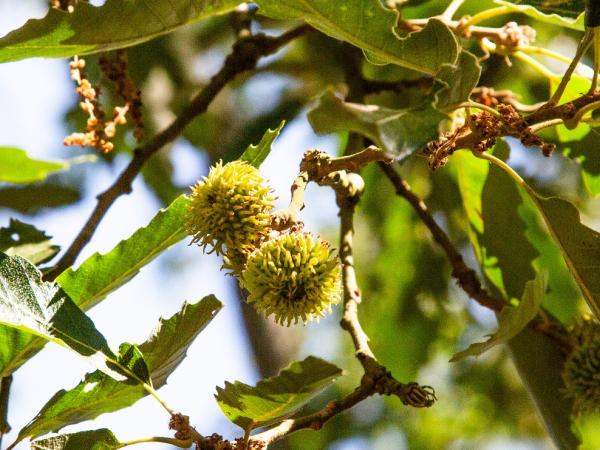
The only oak species endemic to Africa is rare in cultivation. It shouldn't be.
The visit to Apple Park and the oak plantation there, during the first Post-Conference Tour, brought to mind another place I had written about previously in this blog, that also involved selecting and planting large oaks: the 911 Memorial at the World Trade Center in New York. Located at opposite sides of North America, separated by 48 degrees of longitude but only 3 degrees of latitude, these places offer striking contrasts. They have oaks in common, but are opposites in many ways—even exact opposites:


- Whereas the concept of the 911 Memorial attempts to anchor in the present a moment from the past, Apple Campus seems to insinuate the future in the present.
- Architecturally, the Memorial is dominated by verticality and straight lines: the invisible presence of the topless towers, the sky-reaching buildings that surround the open space, the square wells that drop into the earth. The campus in Cupertino is about horizontality and curves: the building is a circle encircling a circle and does not rise above four stories, even the glass walls are curved, hardly a straight line in sight.
- The plantation in the Big Apple focuses on one species, swamp white oak (Quercus bicolor), 400 trees planted on a strict grid; at Apple Park there are over 60 oak taxa, laid out in an organic, apparently pattern-less plantation.
The precise nature of this contrapuntal relationship is almost disturbing. Chance? As Jorge Luis Borges once said in a lecture on Dante: "...there is no chance; what we call chance is our ignorance of the complex machinery of causality." *
* Borges, Jorge Luis, and Eliot Weinberger. Seven Nights. New Directions, 2009, p.8.
Content by the Same Author
The International Oak Society acknowledges the generous support of the following institutions:
Supporting Institutional Members



Standard Institutional Members