Editor's Picks

While working on a list of synonyms of European White Oaks...
Roderick Cameron
|
Aug 24, 2026
Report led by The Morton Arboretum will help prioritize oak...
Website Editor
|
Aug 06, 2026
Motivation
I live in the village of Dolné Dubové...
Jozef Čapkovič
|
Jul 20, 2026
Plant Focus
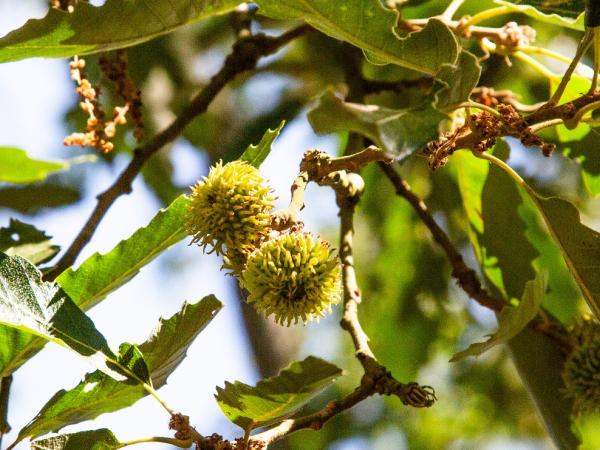
The only oak species endemic to Africa is rare in cultivation. It shouldn't be.
Quercus peninsularis (Pacific Emory oak) is a Red Oak (Section Lobatae) endemic to inland ranges of northern Baja California, Mexico, mainly found in the Sierra de Juárez and Sierra de San Pedro Mártir. In the Sierra de Juárez it is mostly a shrub to small tree. At the south end of its range in Sierra San Pedro Mártir it occasionally grows into a robust tree 15 m in height and spread. It is found at an elevation range of 1,200 to 2,500 m and grows in association with Pinus jeffreyi forests; on the desert scarp, it is a component of desert chaparral understory of P. monophylla and P. quadrifolia forests. The southern limit of the range is Sierra San Luis and Sierra San Borja, where it is found on the summits (Minnich 1987).

The bark is smooth, grayish, later becoming finely fissured and cracked. The slender twigs are somewhat fluted, yellow-tomentose, then glabrescent and reddish-barked in the second season.

The leaves are deciduous, 1.5–3.5 cm wide × 5–8 cm long, leathery, oblong or ovate lanceolate, the base rounded or truncate to cordate, the tip acute, the margin entire or with 2 to 5 pairs of aristate teeth on the upper half of the blade.

The leaves emerge covered in yellowish stellate tomentum then become shiny green and glabrescent with sparse yellow hairs above.

The undersides remain covered in indumentum that easily rubs off, with dense yellow tufts of stellate hair on the vein axils towards the base.

The cupules are cup-shaped, 0.5–0.8 cm high × 0.8–1.0 cm wide, with light brown, tomentose, appressed scales; the nut is cylindrical to elliptical with a pointed apex, up to 1.5 cm long and 1 cm wide, finely hairy, and striped before reaching full maturity; the inside of the cupule is silky. Acorn maturation is annual.

Quercus peninsularis was described by William Trelease (1924) based on a holotype collected by Brandegee in 1893 in San Pedro Mártir. Trelease grouped it, together with Q. devia, in the series Peninsulares (the epithet refers to the peninsula of Baja California). For Miller (1965), the two species are closely related to Q. emoryi and form a natural series together with Q. eduardi and Q. viminea. Quercus peninsularis is similar to Q. emoryi and distinguished mainly by the heavy indumentum of the leaves and twigs, which is quantitatively and qualitatively different from that of Q. emoryi.

According to Miller, Q. peninsularis might have recently been isolated from Q. emoryi, from which it is separated by over 300 kilometers of desert across the delta of the Colorado River. Quercus devia, in contrast, is more distinct from Q. emoryi and is restricted to the Sierra de la Victoria in southern Baja California and so has long been isolated from Q. emoryi by the Gulf of California.

The species is rare in cultivation and recorded only at California Botanic Garden. According to the IUCN Red List, it is assessed as Near Threatened due to its small area of occupancy and continuing habitat destruction for land use change. The species is in need of additional survey work to check population status; it is not assessed as threatened due to a lack of information regarding number of locations and species fragmentation (Jerome and Carrero 2020).

References
Jerome, D. & Carrero, C. 2020. Quercus peninsularis. The IUCN Red List of Threatened Species 2020: e.T30735A2795760. [link]
Minnich, R.A. 1987. The Distribution of Forest Trees in Northern Baja California, Mexico. California Botanical Society 34(22): 98-127 [link]
Muller, C.H. 1965. Relictual origins of insular endemics in Quercus. In: Philbrick, Ralph N., ed. Proceedings of the symposium on the biology of the California Islands. Santa Barbara, Calif. [link]
Trelease, W.L. 1924. The American oaks. Memoirs of the National Academy of Sciences. 20: 1–255. [link]
Photos © Roderick Cameron, taken in Sierra de Juárez, Baja California, Mexico
Content by the Same Author
The International Oak Society acknowledges the generous support of the following institutions:
Supporting Institutional Members



Standard Institutional Members